GEX Flow Evidence: Read Session Flow at Mapped Walls
TradingFlow’s Session flow at mapped walls places same-session options flow beside canonical Call and Put GEX Walls, with transparent Flow-aligned, Flow-against, and Mixed flow verdicts.
A GEX wall tells you where options structure is concentrated. Options flow tells you what traded during the session. Those are related views, but they are not the same evidence.
TradingFlow’s Session flow at mapped walls feature brings them together without pretending they have the same time horizon. It places the selected session’s exact-strike flow beside the canonical Call GEX Wall and Put GEX Wall, then applies a small, visible sign rule:
- Flow-aligned — observed flow points in the conventional direction associated with that wall.
- Flow-against — observed flow points the other way.
- Mixed flow — Net DEX is zero, or trustworthy premium direction conflicts with Net DEX.
This is a comparison, not a prediction. It does not claim that a wall will hold, break, attract price, or reveal dealer intent.
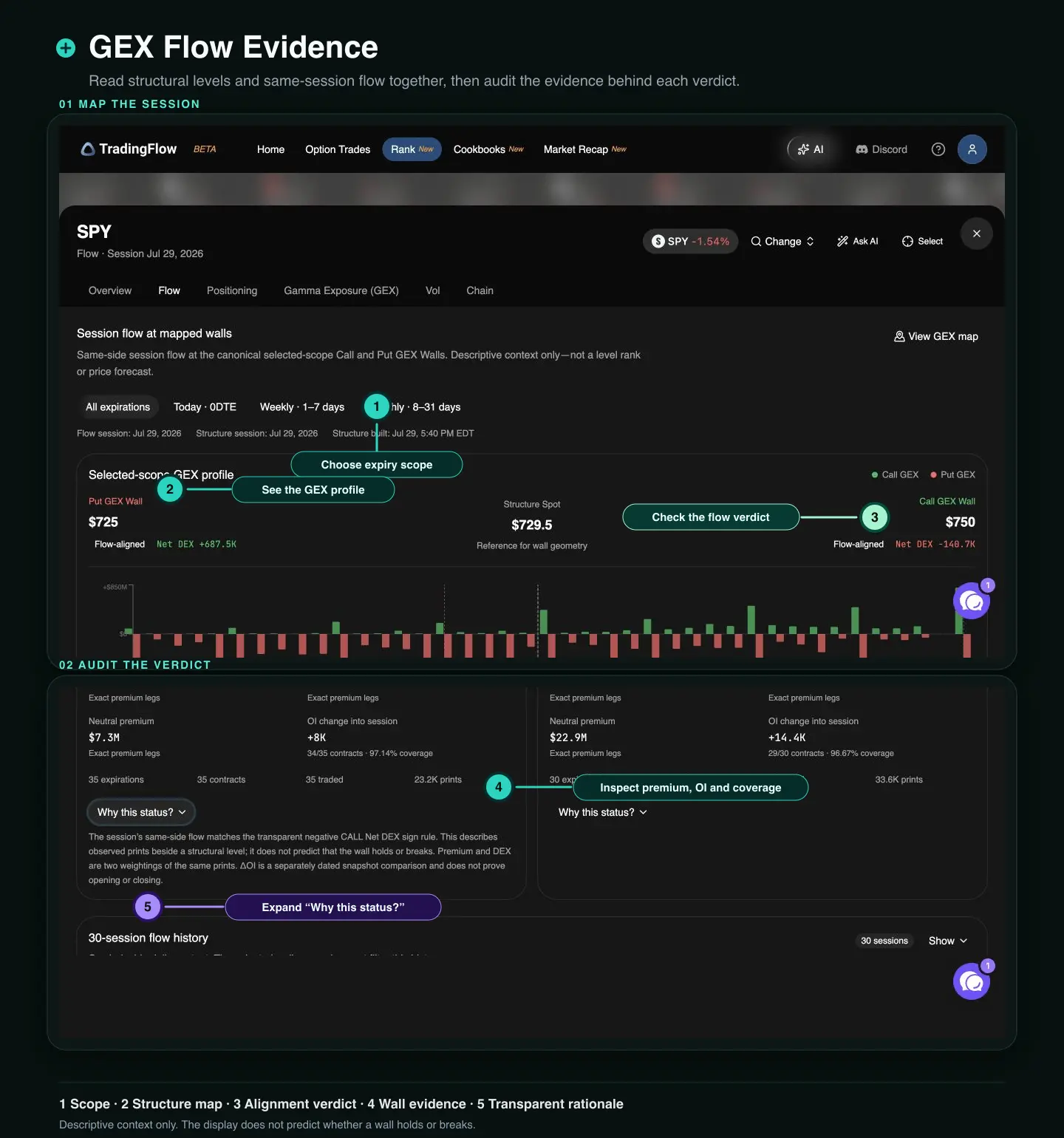
A real SPY session in TradingFlow, annotated in the order traders can inspect it: scope → structure map → verdict → wall evidence → rationale. Session values change as new snapshots become available.
Why combine GEX and flow?
GEX and flow answer different questions:
| Evidence | Question it answers | Time horizon |
|---|---|---|
| Full-chain GEX | Where is gamma structure concentrated? | Structural snapshot |
| Session Net DEX | Which way did same-session directional flow lean? | Current trading session |
| Directional premium | How much bullish, bearish, and neutral premium traded? | Current trading session |
| OI change | How did open interest change versus the comparable prior snapshot? | Separately dated structural comparison |
A Call Wall can be structurally important even when nothing traded there today. Heavy flow can appear at a strike that is not a canonical wall. The useful question is therefore not “Which number wins?” It is:
Is today’s observed flow at the exact wall strike aligned with, against, or inconclusive beside the structural map?
That framing helps traders avoid two common mistakes: treating every large GEX level as an automatic trade signal, and treating same-session flow as proof of dealer inventory.
What TradingFlow matches
The feature does not compare a wall with every nearby option. It uses a deliberately narrow join:
- Select a GEX scope: All expirations, 0DTE, Weekly (1–7 days), or Monthly (8–31 days).
- Read the canonical Call Wall and Put Wall from that same full-chain scope.
- Match flow at the exact normalized strike.
- Use CALL contracts only at the Call Wall and PUT contracts only at the Put Wall.
- Classify only when flow and structure identify the same effective session and the structure build time is available.
The strict matching matters. A nearby strike is not silently substituted. A call row is not used to explain a Put Wall. One expiry scope does not borrow evidence from another.
How the verdict works
There is no composite score and no hidden confidence model.
| Wall | Flow-aligned | Flow-against |
|---|---|---|
| Call GEX Wall | Negative CALL Net DEX | Positive CALL Net DEX |
| Put GEX Wall | Positive PUT Net DEX | Negative PUT Net DEX |
If Net DEX is exactly zero, the result is Mixed flow.
Directional premium can change a verdict to Mixed flow only when TradingFlow has exact, valid bullish, bearish, and neutral premium legs and their direction conflicts with Net DEX. Reconstructed or unavailable premium remains visible as provenance, but it does not overrule the status.
This rule is intentionally simple enough to audit from the numbers on screen.
A concrete example
Assume SPY is trading at $555 and the selected scope identifies:
- Put GEX Wall: $550
- Call GEX Wall: $560
At the $560 Call Wall, the same-session CALL contracts produce:
- Net DEX: −38K
- Bearish premium: $12M
- Bullish premium: $3M
- Observed prints: 184
The result is Flow-aligned. Negative CALL Net DEX satisfies the transparent Call Wall sign rule, and the exact premium split points in the same direction.
What does that mean? It means the session’s observed call-side flow at $560 carried negative directional pressure beside a structurally concentrated call strike.
What does it not mean?
- It does not prove traders opened new bearish positions.
- It does not prove dealers are short or long a particular inventory.
- It does not guarantee $560 will act as resistance.
- It does not assign a probability that price will reject the level.
The phrase “negative flow at the Call Wall” also does not mean one trader deliberately “put negative flow on the wall.” Net DEX is an aggregate of inferred trade direction across matching prints. Call selling, closing long calls, spreads, and other activity can contribute. The feature describes the tape; it does not claim to know each participant’s intention.
Now assume the $550 Put Wall shows +21K PUT Net DEX, with $7M bullish premium versus $2M bearish premium. That is also Flow-aligned under the Put Wall rule. If PUT Net DEX were negative instead, it would be Flow-against.
Read the map before the badge
After you select Load flow evidence, the feature opens with a chart-first view:
- Put Wall, structure Spot, and Call Wall arranged by price.
- Selected-scope Call and Put GEX by strike.
- Net DEX and evidence status beside each wall.
- Separate flow-session, structure-session, and structure-build provenance.
The badge is only the summary. The audit cards below it provide the evidence:
- Wall role, strike, and distance from structure Spot.
- Wall-side share of selected-scope gross GEX.
- Same-side Net DEX.
- Exact, reconstructed, or unavailable premium provenance.
- Matched expirations and contracts.
- Traded contracts and print count.
- Covered OI change and its comparison coverage.
Use Why this status? to see the exact rule applied to the wall.
Missing evidence is not zero
TradingFlow keeps several states separate because they mean different things:
- Wall unavailable — the selected GEX scope has no canonical wall for that side.
- No matching contracts — the wall exists, but the session snapshot has no same-side contracts at the exact strike.
- No observed flow — matching contracts exist, but their summed print count is zero.
- Geometry not classified — the wall is on an unconventional side of Spot, or a valid Spot reference is unavailable.
- Session mismatch — flow and structure do not describe the same session.
- Source unavailable — one of the required datasets did not load.
The interface does not turn missing evidence into a numeric zero or force a bullish/bearish label when the comparison is unsafe.
How to open GEX Flow Evidence
You can begin from either Rank view:
From Rank Contracts
- Open Rank → Contracts.
- Find a contract worth investigating.
- Select Open symbol flow at GEX walls in the Inspect column.
- TradingFlow opens the underlying symbol drawer on Flow while keeping your Contracts filters, sorter, and page intact.
From Rank Symbols
- Open Rank → Symbols.
- Open a symbol’s inspection drawer.
- Select the Flow tab.
Flow Evidence is a paid, user-initiated load. An entitled user selects Load flow evidence before the wall comparison or its values are fetched. Consent is tied to the current symbol and resets when the symbol changes or the drawer closes.
After loading:
- Confirm that the flow session and structure session match.
- Choose All, 0DTE, Weekly, or Monthly.
- Read the GEX profile and Spot/wall geometry.
- Compare the two wall statuses.
- Open the audit cards and check Net DEX, premium provenance, print count, and OI coverage.
- Use View GEX map for the wider structural read.
- Expand the separate 30-session flow history only when you need symbol-wide context.
A practical trading workflow
Treat the feature as an evidence checkpoint between structure and execution:
| Step | TradingFlow surface | Question |
|---|---|---|
| Map | GEX tab | Where are the selected-scope structural levels relative to Spot? |
| Compare | Flow tab | Is same-session exact-strike flow aligned, against, mixed, or unavailable? |
| Audit | Wall evidence cards | How many contracts and prints support the status? Is premium exact? Is OI coverage usable? |
| Validate | Option Trades | Are recent prints and price action confirming the same read? |
| Plan risk | Your execution chart | Where is the setup invalidated if price does something different? |
GEX Flow Evidence should narrow your questions, not make the decision for you. A Flow-aligned Call Wall can still break. A Flow-against Put Wall can still hold. Price, liquidity, news, volatility, and changing intraday flow remain part of the trade.
What the feature intentionally does not do
- It does not rank walls.
- It does not calculate a 0–100 confidence score.
- It does not label a wall as a guaranteed target, magnet, support, or resistance.
- It does not infer dealer inventory from Net DEX.
- It does not treat OI change as proof of opening or closing.
- It does not manufacture a classification when sessions or provenance disagree.
That restraint is part of the product. GEX is the structural map; flow is the observed session tape. TradingFlow shows where they agree and where they do not, while keeping the evidence auditable.
Open the workflow
Open SPY Flow Evidence in TradingFlow
For the underlying concepts, read:
- Gamma Exposure (GEX) explained
- Call Walls, Put Walls, OI, and Max Pain
- Symbol-level analysis in Rank
- GEX Scanner and Screener
This feature is an analytical research tool, not investment advice or a mechanical trading signal.
Related Articles
GEX Scanner & Screener: Gamma Exposure, Call Walls & Put Walls
Use TradingFlow’s GEX scanner inside Rank Symbols for gamma exposure, call walls, put walls, volatility, OI, and option-chain context—after you rank options flow.
Call Walls, Put Walls, and Pin Days: Evidence Before the Magnet Story
Dual walls and pin narratives dominate social feeds. TradingFlow maps Call/Put GEX Walls, then places same-session flow beside them—without predicting a pin.
Options Chart That Matters: GEX, Walls, and Flow—Not a Pretty Candlestick
Looking for an options chart? Map gamma exposure, call/put walls, and same-session option flow in TradingFlow Rank—not just another price chart.