
Not Every Rally Has Flow Behind It: How I Read Top Gainers — Flow Confirmation on TradingFlow
TradingFlow scored 63 single-name gainers on Aug 14 — 50 confirming, 13 neutral, zero diverging. The single biggest mover of the day wasn't one of the confirming names. Here's a real session and what that gap actually means.
A stock ripping 15% higher gets everyone's attention. The options tape underneath it gets almost none. That's backwards. The price move is the headline, but the flow is what tells you whether size showed up behind it or the options market mostly shrugged. A few weeks back I wrote about catching accumulation before a move — quiet open interest building before anyone's talking about a name. This is the other half of that question: the stock already moved. Did the flow actually agree?
TradingFlow's Cookbooks has an official recipe for exactly this — Top Gainers — Flow Confirmation. Here's a real session, read the way I'd read it myself.
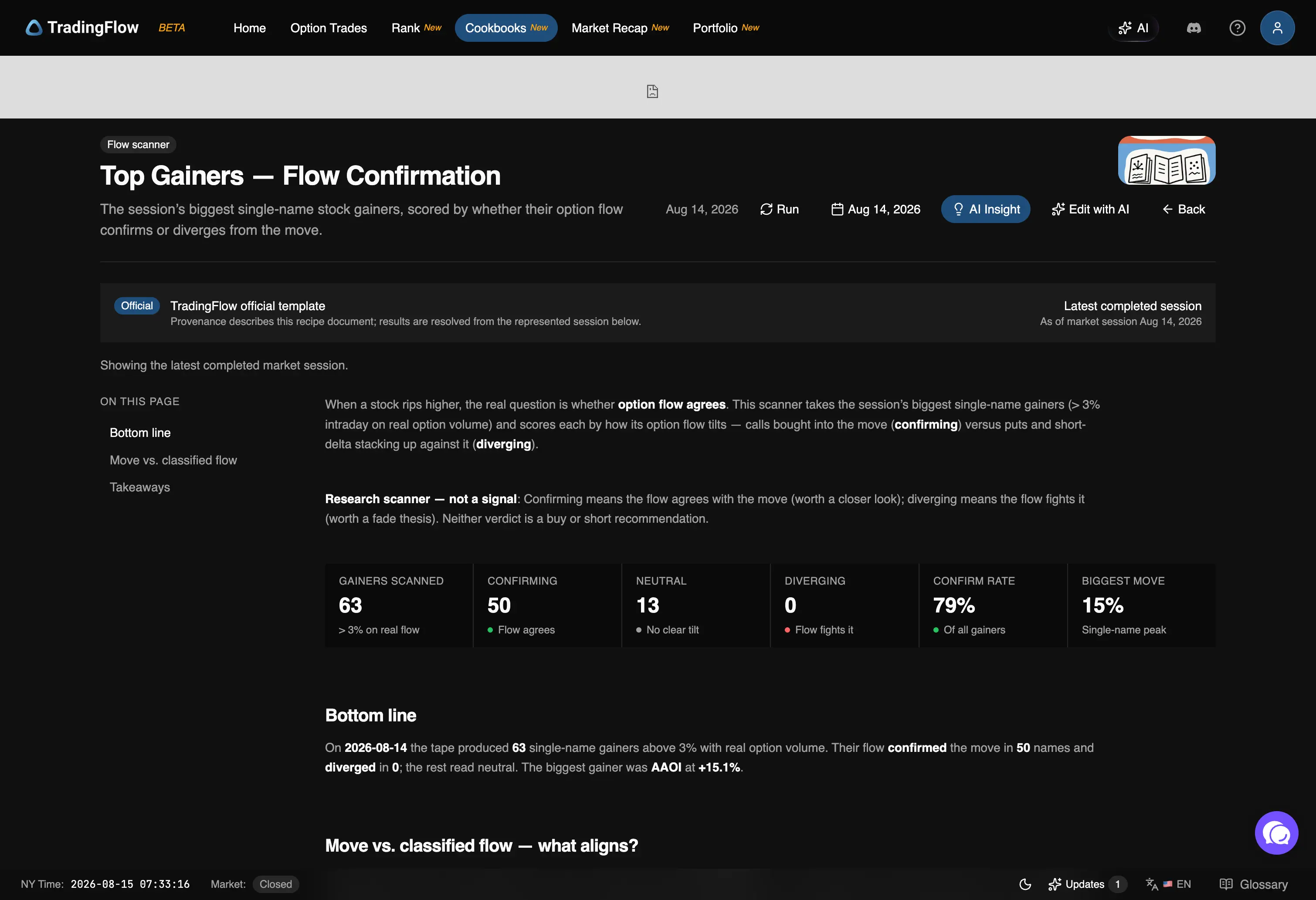
The framing up top, worth reading before any of the numbers below: "Research scanner — not a signal. Confirming means the flow agrees with the move (worth a closer look); diverging means the flow fights it (worth a fade thesis). Neither verdict is a buy or short recommendation."
What the screen is actually doing
It takes every single-name stock that moved more than 3% intraday on real option volume, then scores each one by flow tilt — net DEX as a signed share of that name's option premium. Calls bought aggressively into the move push the tilt up (confirming). Puts or short-delta stacking up against the move push it down (diverging). When the classified execution evidence doesn't lean either way, the name reads neutral. The classification comes from option type and quote-side execution — it doesn't prove a position, and it doesn't prove intent.
The session, in numbers
For the session of Aug 14, 2026, the tape produced 63 single-name gainers above 3% with real option volume:
- 50 confirming — flow agreed with the move
- 13 neutral — no clear tilt either way
- 0 diverging — flow fighting the move
- 79% confirm rate
- Biggest single-name move: +15.1% (AAOI)
Zero diverging names is the number I'd normally be suspicious of — a screen that never fires one of its own categories is worth a second look, not an automatic pat on the back. But nothing here looks like a broken threshold: this was a broad, one-directional tape, and 13 neutral names sitting right next to 50 confirming ones is exactly the shape you'd expect from a session where option buyers mostly chased strength instead of fading it. I'm noting the zero honestly rather than reading a story into it — one session doesn't establish whether "diverging" ever fires in practice.
The name that should have been the headline case — and wasn't
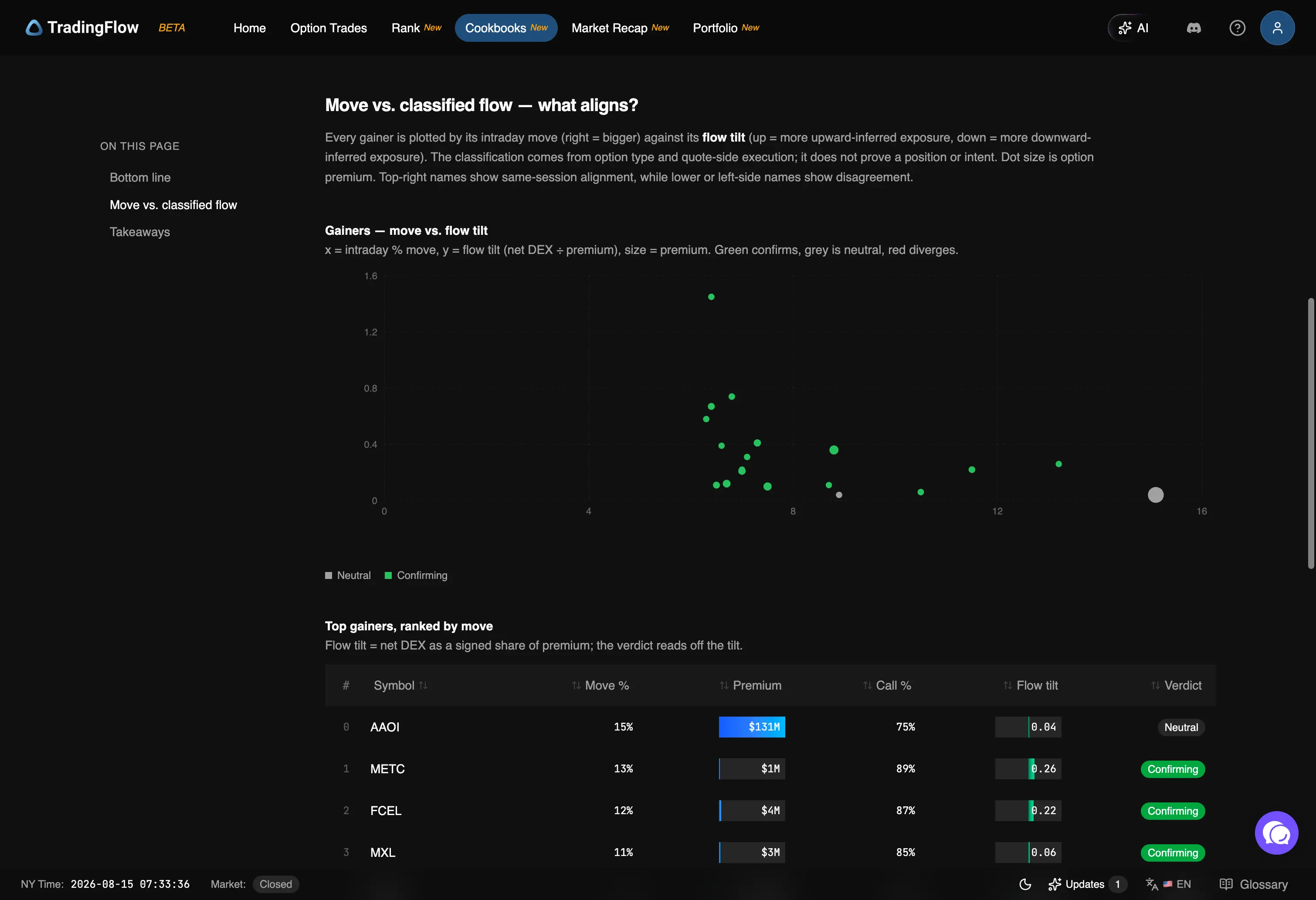
Every gainer plotted by move (x-axis) against flow tilt (y-axis), dot size = premium. Find the one large dot sitting almost on the floor, off on its own — that's the name the rest of this section is about.
The session's biggest mover was AAOI, up 15%, and it wasn't close — the next-biggest move was METC at 13%. AAOI also carried, by a wide margin, the largest option premium of any gainer that day: $131M, against mostly single-digit-million premium for everything else on the board. Three-quarters of that premium was calls.
By the instinctive reading — biggest move, biggest premium, mostly calls — AAOI should be the cleanest confirming case on the whole board. It's rated Neutral. Flow tilt: 0.04, barely off zero.
Here's why, and it's the report's own point made concrete: flow tilt isn't raw dollars and it isn't raw call percentage. It's net DEX as a signed share of premium. $131M of premium with a 75% call skew can still net out close to flat if enough of that flow was offsetting — puts alongside the calls, spreads, executions that don't resolve to a clean directional lean. The size was real. The direction, once you net it out the way the screen does, wasn't there. A move that big, on that much premium, with that little net directional signal, is a more interesting research question than a stock that quietly confirmed — it's a specific, answerable "why didn't this show up net-directional," not a foregone conclusion.
The contrast: small, unglamorous, and clean
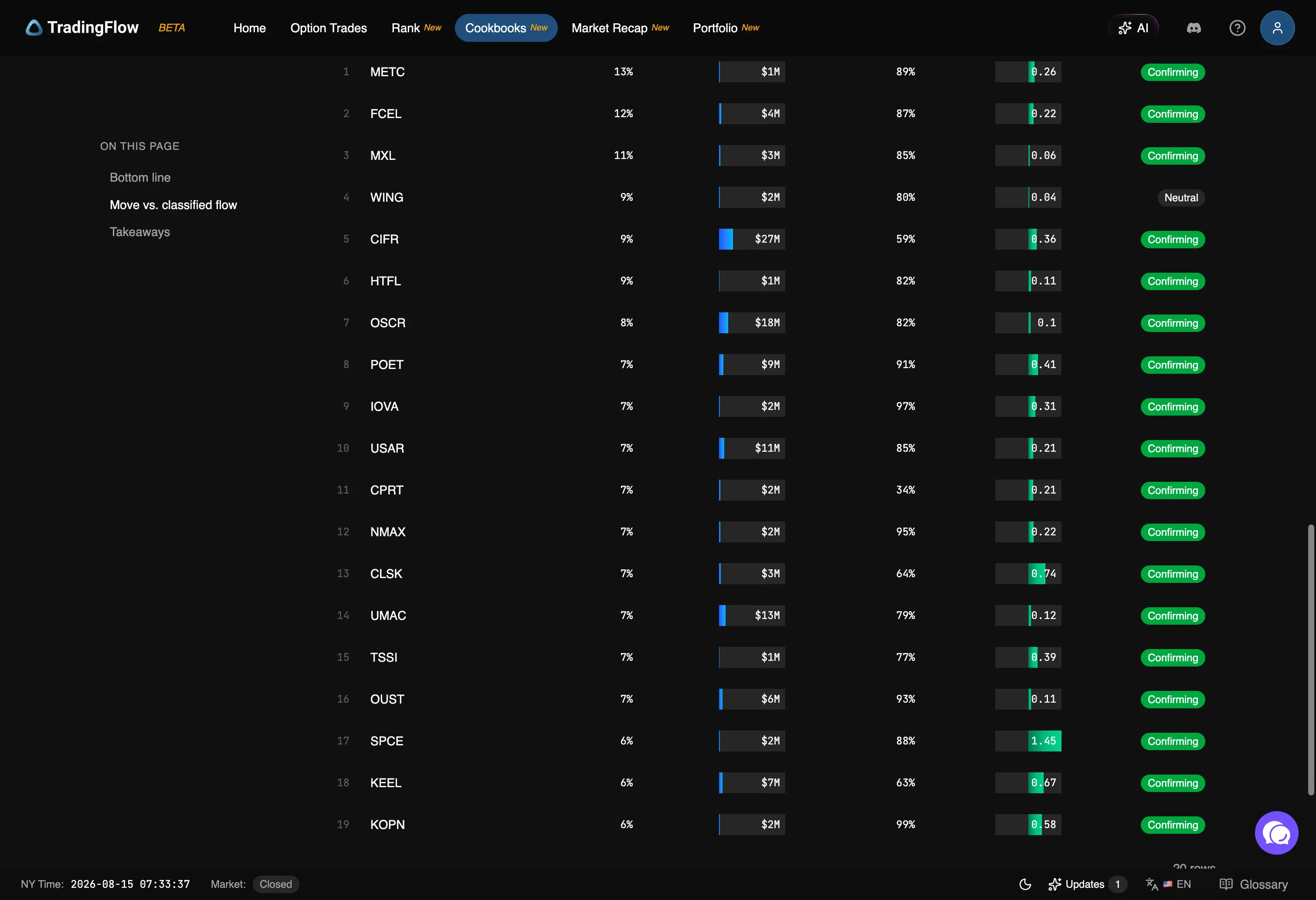
The board itself. Same session, ranked by move — AAOI's row is off-screen above this crop, but METC, CPRT, and WING are all right here with their actual flow-tilt numbers.
METC moved 13% on $1M of premium — a rounding error next to AAOI's $131M — and came out Confirming at a flow tilt of 0.26, several multiples cleaner than AAOI's. A name almost nobody was watching had a more legible signal than the day's biggest story.
Two more details from the board worth holding onto:
- CPRT confirmed with only 34% calls — the lowest call share of any confirming name in the top twenty. Flow tilt is about net DEX, not raw call percentage, so a name can lean call-minority and still confirm if the calls that are there are aggressively directional relative to the puts.
- WING stayed Neutral on a modest $2M of premium, nowhere near AAOI's size. Neutral isn't a big-name artifact — it shows up at small size too, whenever the signed flow just doesn't lean.
What the report's own takeaways say, in plain language
- Confirming / diverging / neutral describe execution evidence, not certainty. Confirming means the classified flow leaned the same way as the move; diverging means it leaned against it; neutral means the evidence didn't establish a direction at all. None of the three is a prediction.
- The biggest premium name is not automatically the strongest case. Read the flow-tilt math, not the dollar sign next to it — AAOI is the session's own proof of this.
- One session is a tape, not a thesis. Cross-check every name against its chain and later sessions before treating a verdict as anything more than a starting point.
How I actually use it
I don't scan this list top-to-bottom looking for green "Confirming" pills to feel good about. Confirming, on a session like this one, is the majority outcome — 50 out of 63 — so it's not the surprising part. What I actually look for:
- Sort by move, not by premium, and check the top few names against their Verdict first. A huge mover that isn't confirming is the one worth a second look.
- Compare premium size to flow tilt, not either alone. A name can be small and clean (METC) or huge and washed-out (AAOI) — the dollar figure alone tells you activity happened, not which way it leaned.
- Cross-check the interesting names in Option Trades for the actual prints — was the offsetting activity puts, spreads, or something that doesn't resolve cleanly either way.
- Treat "diverging" as a fade thesis to research, not a trade. The report says this outright, and it's worth repeating: divergence is a question to dig into, not a signal to act on by itself.
Open it
Open Top Gainers — Flow Confirmation in TradingFlow
For the concepts behind this screen:
- Cookbooks & Market Recap tutorial — how official recipes like this one work
- Delta Exposure (DEX) explained — what net DEX actually measures
- Options & Flow Concepts — reading side, sentiment, and a print honestly
- Pre-Move Positioning — OI Accumulation — the same honesty applied before a move instead of after
This is a research tool, not a signal generator. A Confirming or Diverging verdict describes one session's classified option flow — it does not identify a trader, prove intent, or predict what happens next. Do your own research, and treat a mismatch between the size of a move and the size of its flow signal as a question worth asking, never an answer.
Related Articles
Before Anyone's Talking About It: How I Read OI Accumulation on TradingFlow
Every morning before I look at anything else, I open TradingFlow's Pre-Move Positioning screen. Here's a real session — three PCG call strikes building open interest at once — and exactly how far that pattern gets you, and where it stops.
$3.2 Billion in One Name Wasn't a Bullish Bet: How I Read Daily Option Flow on TradingFlow
TradingFlow's Daily Option Flow scanner showed $20B in single-name option premium on Aug 14 — and 16% of it landed in one name, SNDK. The size looked bullish. The biggest individual tickets said something messier. Here's how I actually read a session's tape.
Unusual Options Activity Is Not a Signal Until the Tape Checks Out
UOA alerts are noise without filters, print-level tape, and open-interest context. TradingFlow’s Option Trades and Rank surfaces make that audit possible.