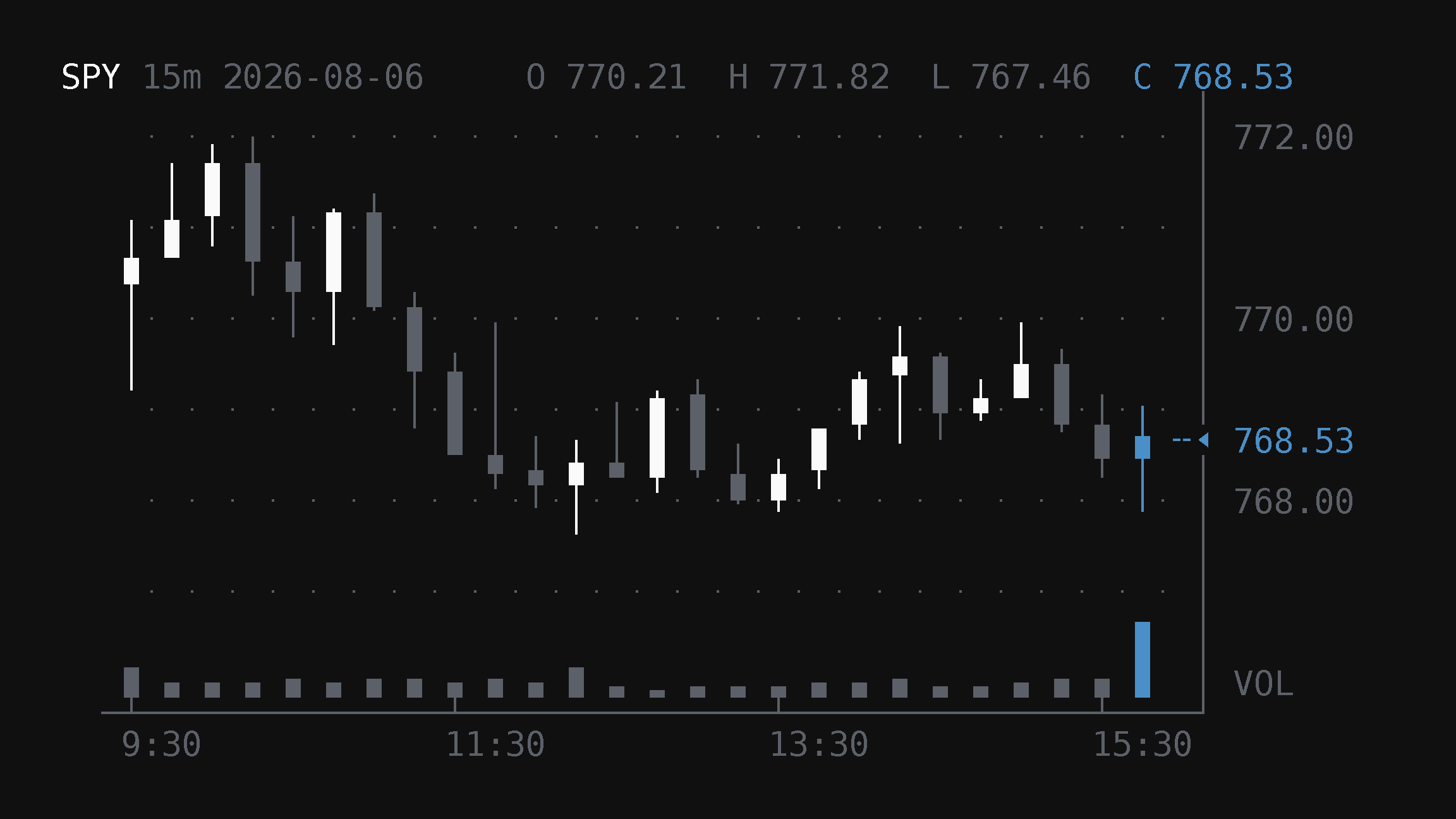
SPY / SPX / QQQ 0DTE: Read the Tape Before the Pin Story
Same-day index options dominate trader chat. TradingFlow’s evidence loop is Rank → Option Trades tape → GEX/walls structure—not a 0DTE signal feed.
0DTE (zero days to expiration) on SPY, SPX/SPXW, and QQQ is the loudest US options conversation on X and Reddit. Traders argue about pin, premium burn, expected move, and end-of-day traps. Most of that debate skips one step: what actually printed on the public tape, and how it sits next to structure.
TradingFlow is built for that step. It is not a 0DTE casino or tip service. It is an evidence stack:
- Rank — which underlyings and contracts matter in this session
- Option Trades — the print-level tape (live or historical)
- Structure — GEX, call walls, put walls inside Rank Symbols
This article walks that loop with app surfaces you can reproduce. Educational market-structure research only—not investment advice.
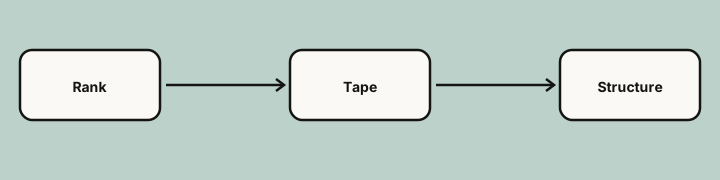
The 0DTE research loop: rank the session, read the tape, then check structure. None of the steps alone is a trade signal.
Why 0DTE needs evidence, not slogans
Same-day options compress time. Screenshots and P&L flexes are easy to share—and easy to misread:
| Claim style | What public data can support | What it cannot prove |
|---|---|---|
| “Pin to strike X” | Heavy GEX/OI concentration near X; same-day flow at X | That price will pin, or that dealers “want” a pin |
| “Premium burn day” | OTM prints that later expire worthless (after the fact) | That you should have sold them |
| “Smart money bought calls” | Size, premium, side labels, Vol/OI heuristics on the option flow / UOA tape | Account identity, open vs close, multi-leg intent |
The useful question for an index day is:
What does the tape show for SPY / SPXW / QQQ today, and how does that sit next to mapped walls and GEX?
Step 1 — Rank the session
Open Rank Symbols. Read session cards and the ranked table before zooming into a single print.
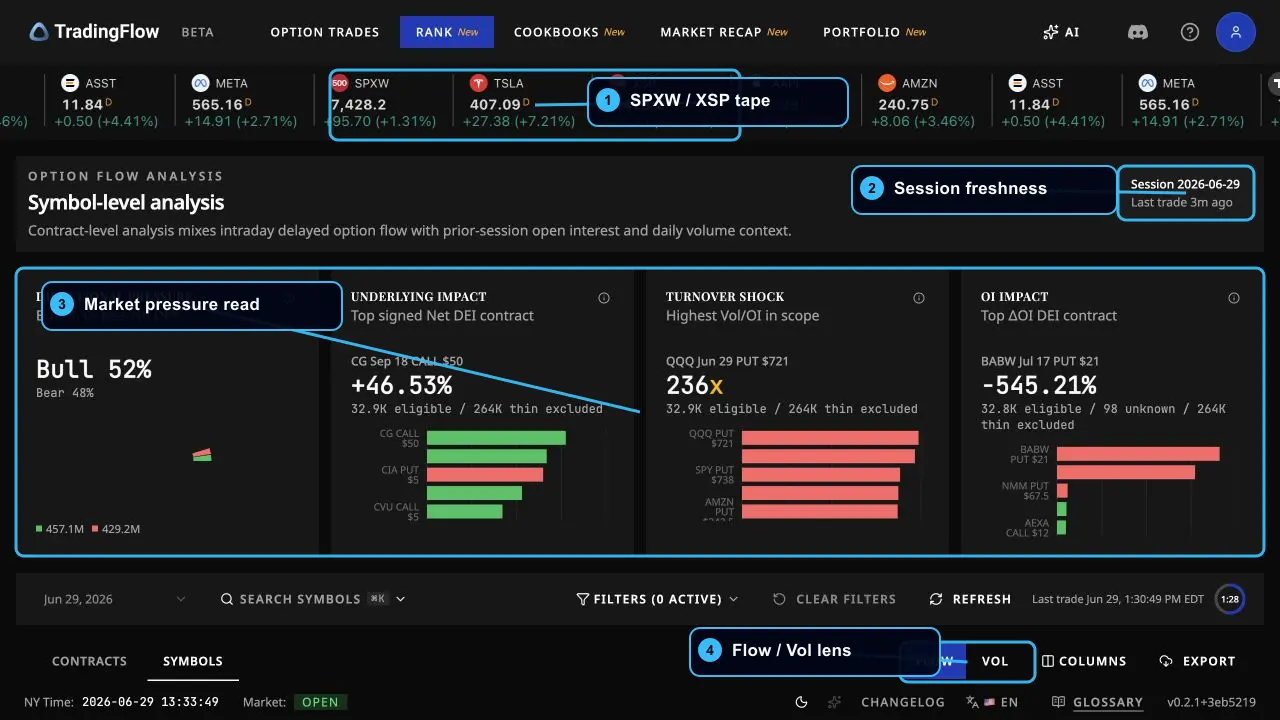
Rank Symbols is the market-level start: session freshness, directional pressure, and which underlyings dominate. It does not tell you which single contract to buy.
For index 0DTE work, keep SPY, SPXW / XSP, and QQQ in the watch set. SPX cash-settled index options and SPY ETF options are related but not identical.
Then open Rank Contracts when you need contract-level candidates.
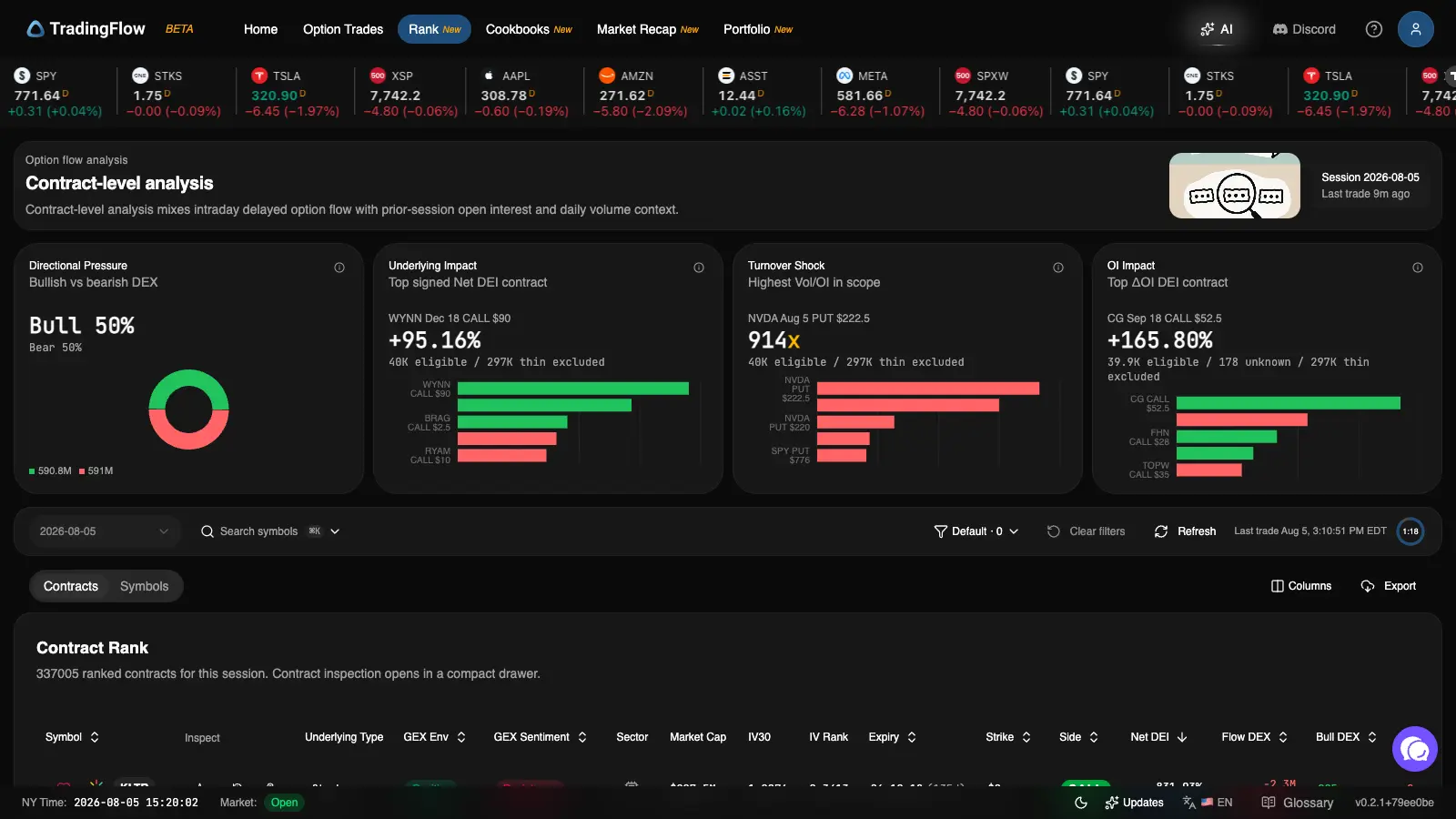
Contract Rank shortlists contracts by session impact metrics. Treat it as a candidate list that still needs tape and structure checks.
Step 2 — Read the Option Trades tape
Open Live Option Trades. On an active session you will see SPXW and SPY rows with 0d expiry, side (Bid / Mid / Ask), premium, Vol/OI, IV, and sentiment labels.
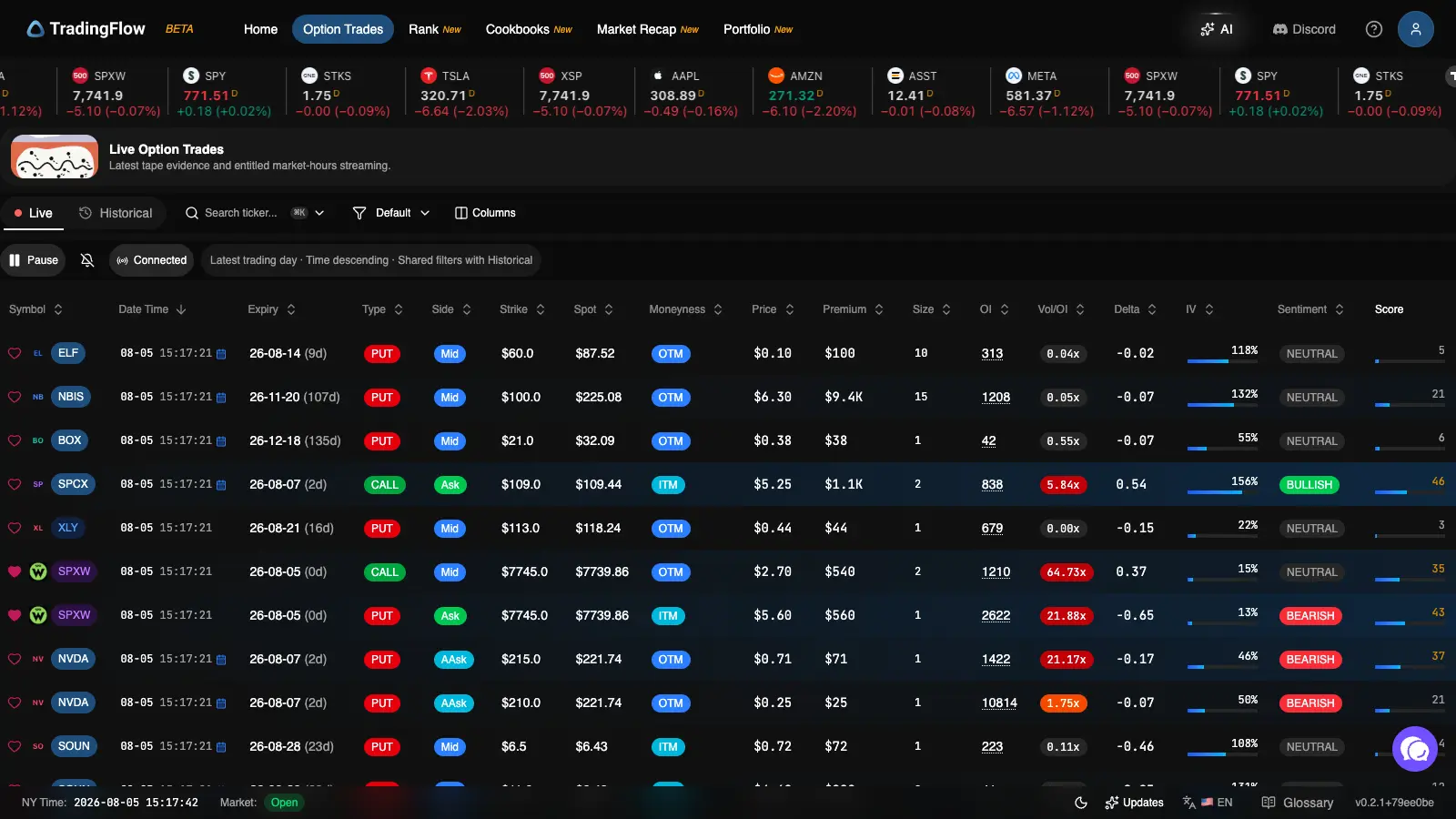
Live Option Trades (session capture). Note 0DTE SPXW rows and print-level fields. Side labels describe quote location, not proven account intent. Data may be delayed or entitlement-gated.
For research after the fact, switch to Historical Option Trades. Set date, New York time window, symbol, type, and strike when you need an exact replay.
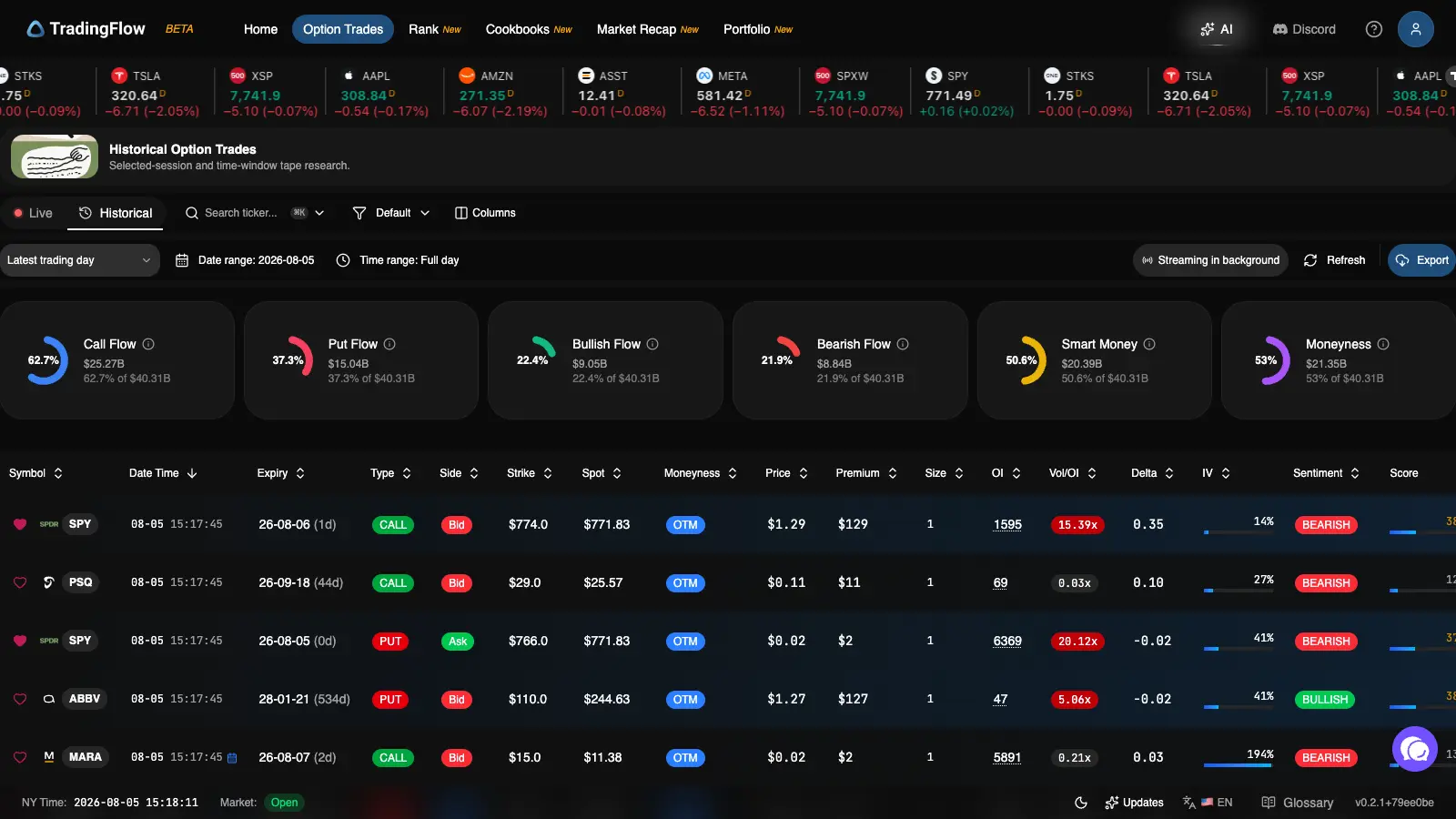
Historical mode adds session aggregates (call vs put flow, bullish vs bearish, moneyness mix) plus the filterable tape. Use it to validate a claim with a fixed date and window.
Reproduction recipe (public app):
- Sign in at app.tradingflow.com
- Choose Live or Historical
- Search SPY, SPXW, or QQQ
- Filter by expiry / type / strike as needed
- Read premium, size, side, Vol/OI, and time—not only the score column
Open Live Option Trades and apply the same recipe on the current session.
Step 3 — Map structure (GEX and walls)
Inside Rank Symbols, open a symbol drawer (for example SPXW or SPY) and use the GEX and Chain tabs.
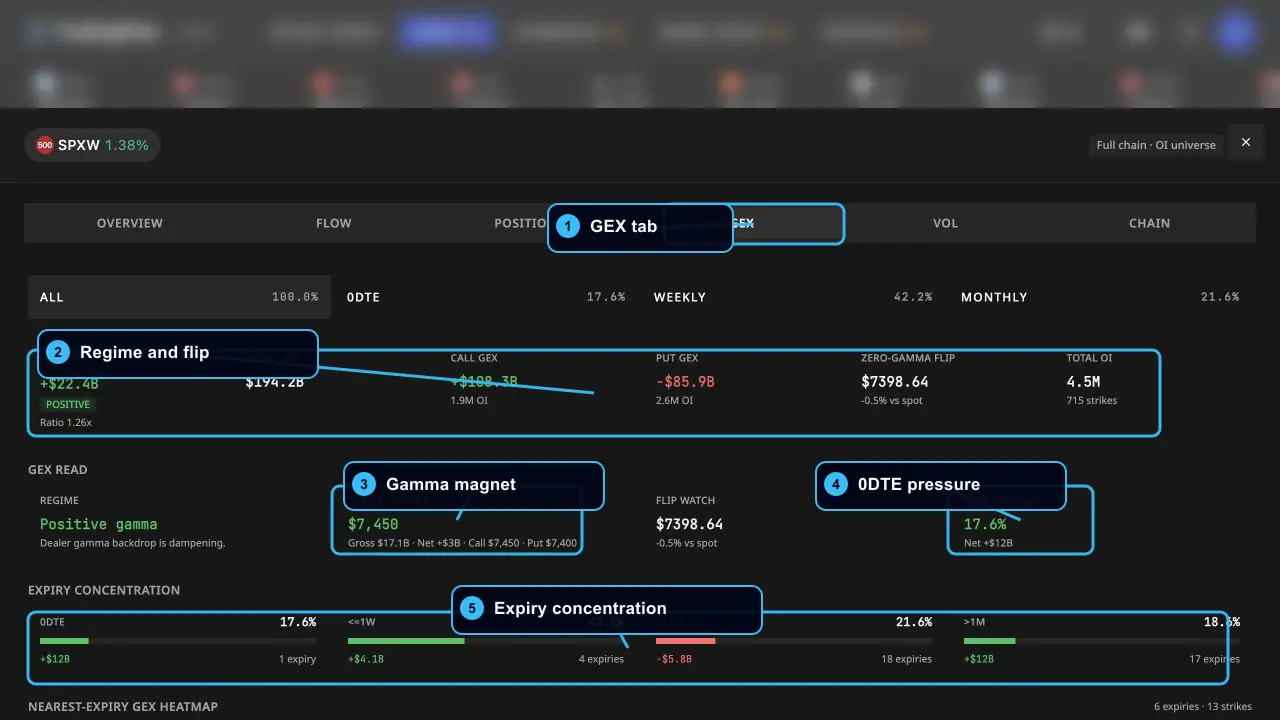
GEX structure for an index options underlier. Read regime and flip first, then gamma concentration by strike and expiry bucket—including 0DTE share. Structure is a snapshot map, not a guarantee of pin.
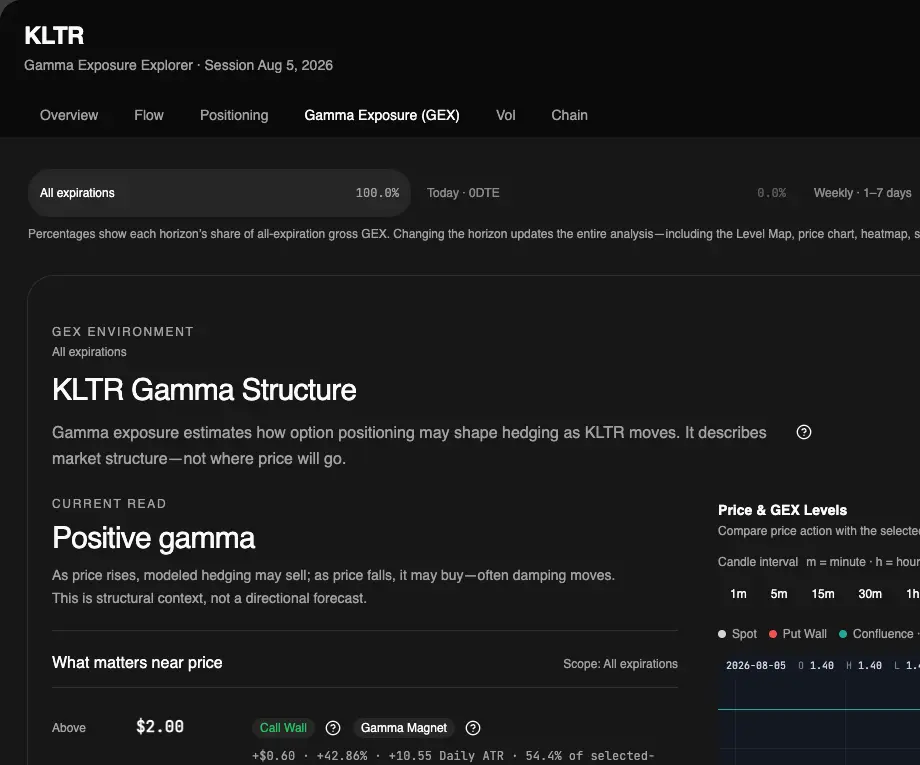
Fresh drawer capture: Gamma Exposure (GEX) tab with expiry-scope chips (including Today · 0DTE). Open any ranked symbol with Open symbol drawer, then switch tabs—deep-link query params alone may not open the sheet.
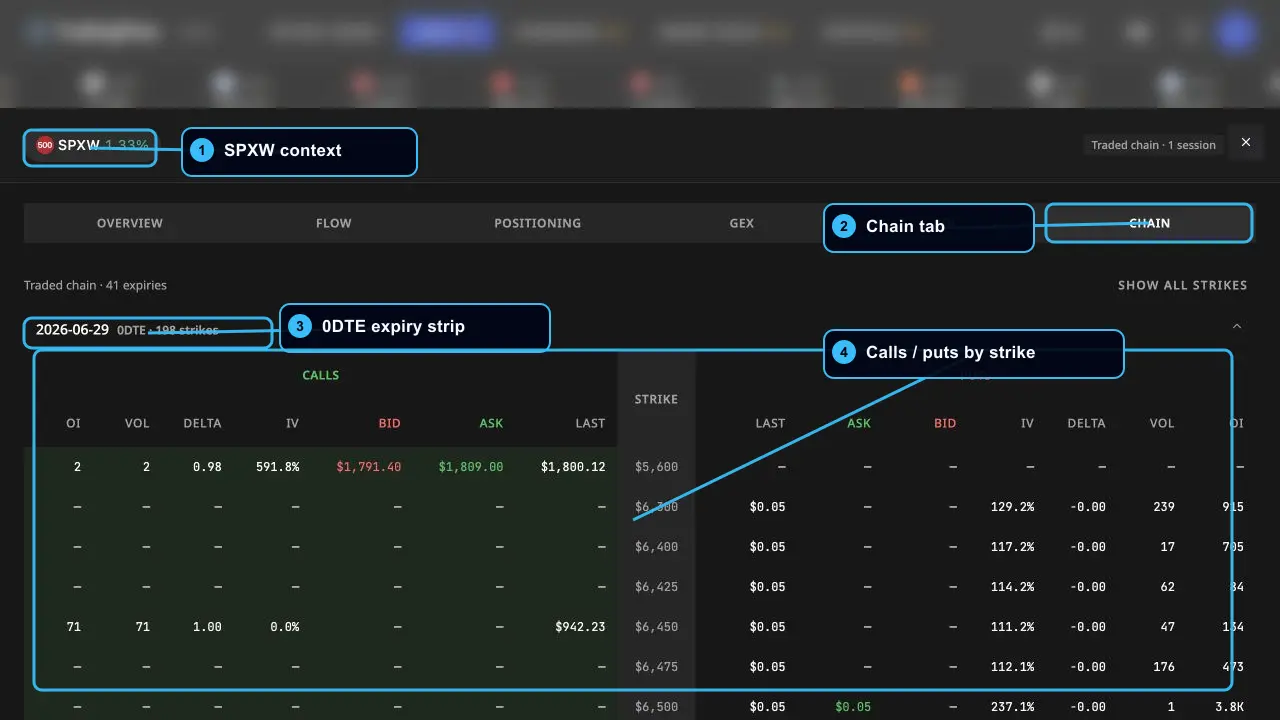
Chain context keeps the strike ladder visible while you mark levels on your execution chart. Busy strikes still need tape confirmation.
Pair structure with Session flow at mapped walls when you want same-session flow at exact Call / Put GEX Wall strikes—with transparent Flow-aligned / Flow-against / Mixed labels.
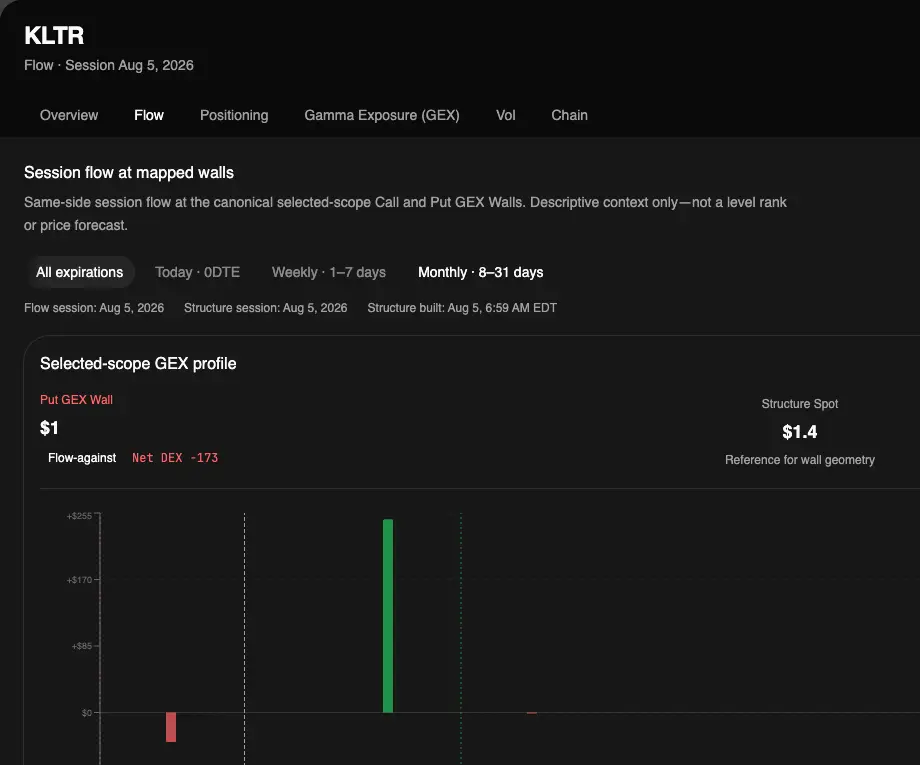
After Load flow evidence, the Flow tab places same-session Net DEX beside mapped walls. Use it as a checkpoint before treating a pin story as settled.
A practical 0DTE session checklist
| Order | Surface | Question |
|---|---|---|
| 1 | Rank Symbols | Is the session fresh? Which underlyings dominate premium/DEX? |
| 2 | Rank Contracts | Which SPY/SPXW/QQQ contracts show unusual impact? |
| 3 | Option Trades | What printed, at what side/premium/Vol/OI, at what NY time? |
| 4 | GEX / Chain | Where are walls, flip, and 0DTE concentration vs spot? |
| 5 | Your chart | Where is your invalidation if price does something else? |
Risk culture that matches the tape (not the lottery flex)
X still fills with EOD lotto recaps and “never average down on SPY 0DTE” process posts. TradingFlow does not score those setups. It does help you see whether a level you care about actually had prints, and whether structure is 0DTE-heavy that day.
Useful personal rules that pair with evidence (not product signals):
- Size to the setup; do not add to a dead 0DTE loser to “get even.”
- Treat stop-outs as closed trades; a new level is a new thesis.
- Prefer defined risk when the GEX tab shows fragile or negative-gamma backdrops.
What this does not do
- It does not predict pin, breakout, or EOD trap probability.
- It does not identify “smart money” accounts.
- It does not replace risk rules (max loss, size, no revenge 0DTE).
- Delayed data, entitlements, and snapshot horizons still apply—label them when you share evidence.
Related posts in this series
- Call walls, put walls, pin
- Negative GEX regime language
- UOA validation
- Rank → tape → structure vs alerts
Learn more
- What is 0DTE?
- Option flow · Unusual options activity
- Option Trades tutorial
- Greeks and GEX
- Option chain, walls, and OI
- Options flow for index traders
- Best options flow tools · Best GEX tools
- ES/SPX intraday workflow
- GEX Flow Evidence
Open the app
Start at TradingFlow App Home, then run Rank → tape → structure on today’s SPY / SPXW / QQQ session.
This article is for education and product demonstration only. Options involve substantial risk of loss.
Related Articles
Call Walls, Put Walls, and Pin Days: Evidence Before the Magnet Story
Dual walls and pin narratives dominate social feeds. TradingFlow maps Call/Put GEX Walls, then places same-session flow beside them—without predicting a pin.
Max Pain Is Not a Pin Forecast: Walls, GEX, and the Tape
Max pain theory is a popular expiration narrative. TradingFlow maps OI walls and GEX next to same-session flow so you do not trade a single pin number blind.
Options Chart That Matters: GEX, Walls, and Flow—Not a Pretty Candlestick
Looking for an options chart? Map gamma exposure, call/put walls, and same-session option flow in TradingFlow Rank—not just another price chart.