
Duan Yongping's SpaceX (SPCX) Put Strategy: Buy at $91.80?
Did Duan Yongping use SPCX put options to buy SpaceX at $91.80? TradingFlow checks the $2.32M premium, 1,000-contract claim, and tape evidence.
On July 25, 2026, WiseInvest (@WiseInvest513) posted a broker screenshot and wrote that Duan Yongping had just hung an $11.5 million SpaceX bid through puts. This article follows that post's four steps, then puts the same contract on TradingFlow's historical option flow tape.
段永平直接给 $SPCX 挂了一张 1150 万美元的接货单
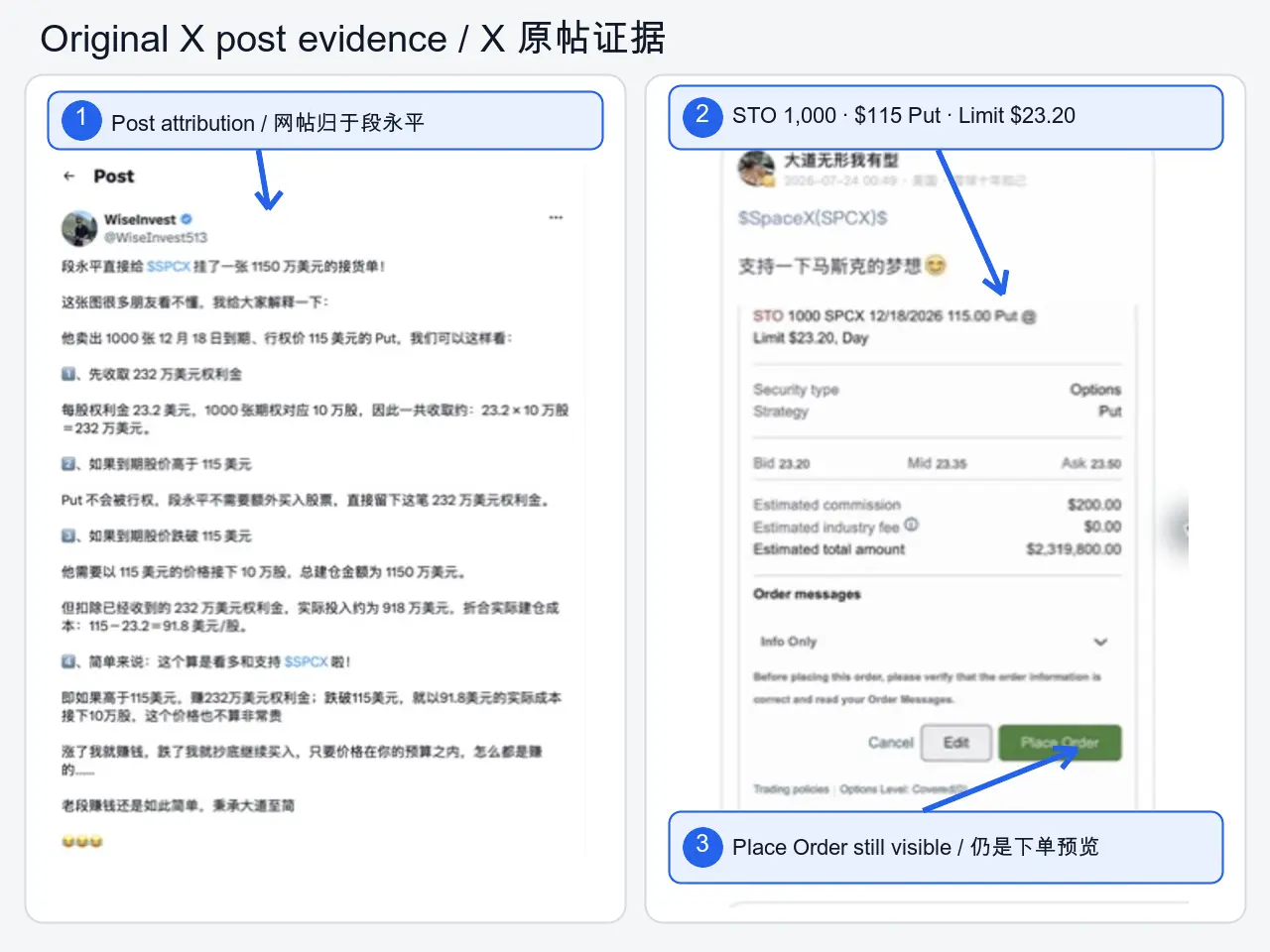
Original post from WiseInvest (@WiseInvest513), captured August 1, 2026. Callout 1 preserves the post's attribution to Duan Yongping. Callout 2 isolates the reported STO 1,000 SPCX $115 puts at a $23.20 limit. Callout 3 shows that the broker screen still displays "Place Order."
The broker screen in the post reads:
STO 1,000 SPCX 12/18/2026 115 Put @ Limit $23.20, Day
The original post's four points, in its own order:
- Collect $2.32 million of premium first. $23.20 × 100,000 shares.
- If SPCX finishes above $115, the puts expire, and the seller keeps the $2.32 million.
- If SPCX finishes below $115, accept assignment of 100,000 shares at $115 ($11.5 million gross). Net of premium, the effective entry is $91.80.
- "If it goes up I get paid. If it goes down I buy the dip." The post calls that a bid to own SpaceX, not an income trade.
The ticket also shows an estimated $200 commission and a Place Order button. Those fields describe a prepared sell-to-open limit. They are not a fill: no order status, filled quantity, average price, or execution time.
Who is Duan Yongping?
Duan Yongping is an entrepreneur turned value investor whose reputation was built long before this SPCX screenshot. A KrASIA profile of Duan traces his role in building BBK and the businesses that later became OPPO and vivo. The same profile recounts his early-2002 purchase of more than $2 million of NetEase shares near $0.80 while the company was deeply out of favor.
His public investing persona centers on patience, concentration, and understanding the underlying business rather than trading the headline. Notes from his Stanford conversation describe his connection to OPPO and vivo, his 2006 winning bid for Warren Buffett’s charity lunch, and his “Stop Doing List”—the idea that resisting the wrong action can matter more than constantly finding something new to do.
That history does not authenticate the SPCX order. It explains why the attribution became compelling: a large short-put position, designed to collect premium or acquire a desired asset after a decline, fits the public image of a patient value investor.
Why this looks like a $91.80 buy-the-dip strategy
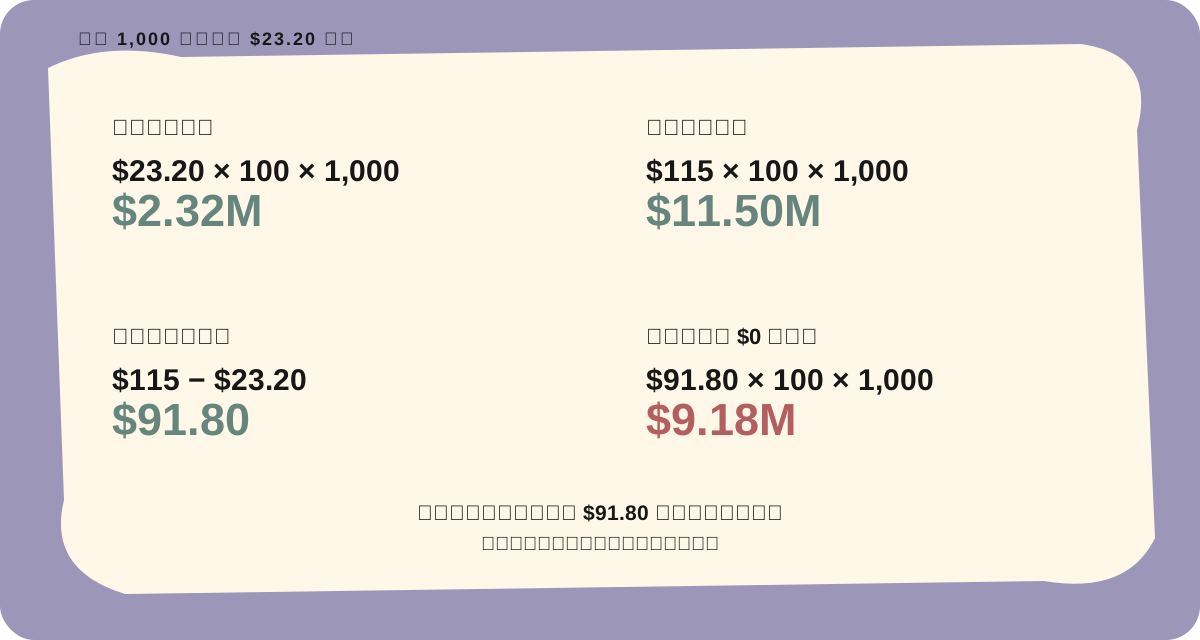
If all 1,000 puts filled at $23.20, the strategy’s economics would be:
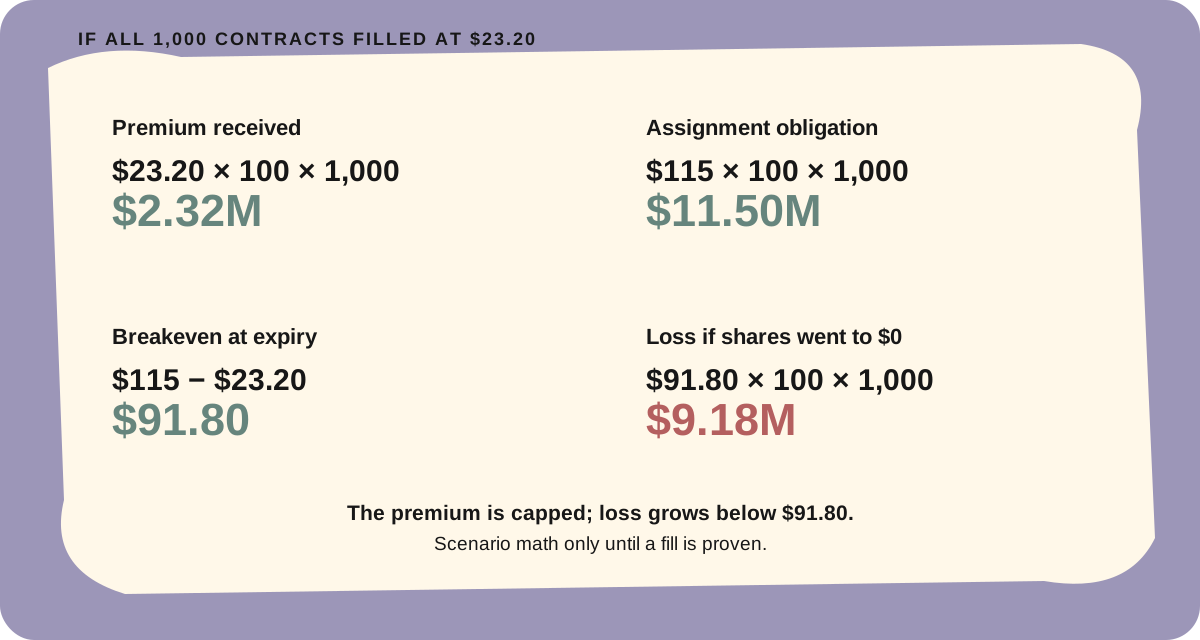
This is scenario math, not proof of execution. It shows how a short put can function as a paid commitment to buy at a lower effective price.
- Gross premium: $23.20 × 100 × 1,000 = $2,320,000
- Estimated net after the displayed $200 commission: $2,319,800
- Gross assignment obligation: $115 × 100 × 1,000 = $11,500,000
- Expiry breakeven before other costs: $115 − $23.20 = $91.80 per share
- Maximum premium gain: $2.32 million before fees
- Loss if the shares went to zero: $91.80 × 100 × 1,000 = $9.18 million before fees
At expiry, three paths matter:
- SPCX at or above $115: the puts can expire worthless and the seller keeps the premium.
- SPCX between $91.80 and $115: assignment buys the shares at $115, but the premium reduces the effective cost to $91.80, leaving the position ahead at expiry while SPCX remains above that level.
- SPCX below $91.80: losses grow dollar-for-dollar as the shares fall, offset only by the premium already collected.
For an investor who already wants the underlying exposure, a cash-secured short put can resemble a paid limit order. The crucial difference is obligation: once assigned, the seller cannot simply decline the purchase. Calling this a buy-the-dip move therefore makes sense only as a description of the intended strategy—not as proof that it was submitted, filled, or profitable.
The alleged intention can be inferred from the order structure:
“If SPCX stays above $115, keep the $2.32 million premium. If it falls below $115, accept assignment at an effective $91.80 entry.”
That is a strategy interpretation, not a verified statement from Duan Yongping.
Tape versus the original ticket
We converted each part of the viral report into a testable market-data claim, then checked the exact contract in TradingFlow’s historical option flow tape for July 24, 2026.
| Claim in the viral report | How TradingFlow tests it | Finding | Verdict |
|---|---|---|---|
| The $115 put traded near $23.20 | Filter SPCX, date, expiry, type, and strike | A 30-contract print appeared at $23.19 | Supported |
| One 1,000-contract order filled | Add Size ≥ 1,000 | Zero matching prints | Not verified as a single fill |
| It was sell-to-open | Compare trade size, volume, OI, and Opening Position context | Tape has no broker-side open/close instruction | Not verified |
| It belonged to Duan Yongping | Identify the account behind the print | Public tape is anonymous | Cannot be verified from market data |
| The strategy collects $2.32M with a $91.80 breakeven | Recalculate the displayed order | Math is correct if fully filled at $23.20 | Conditionally correct |
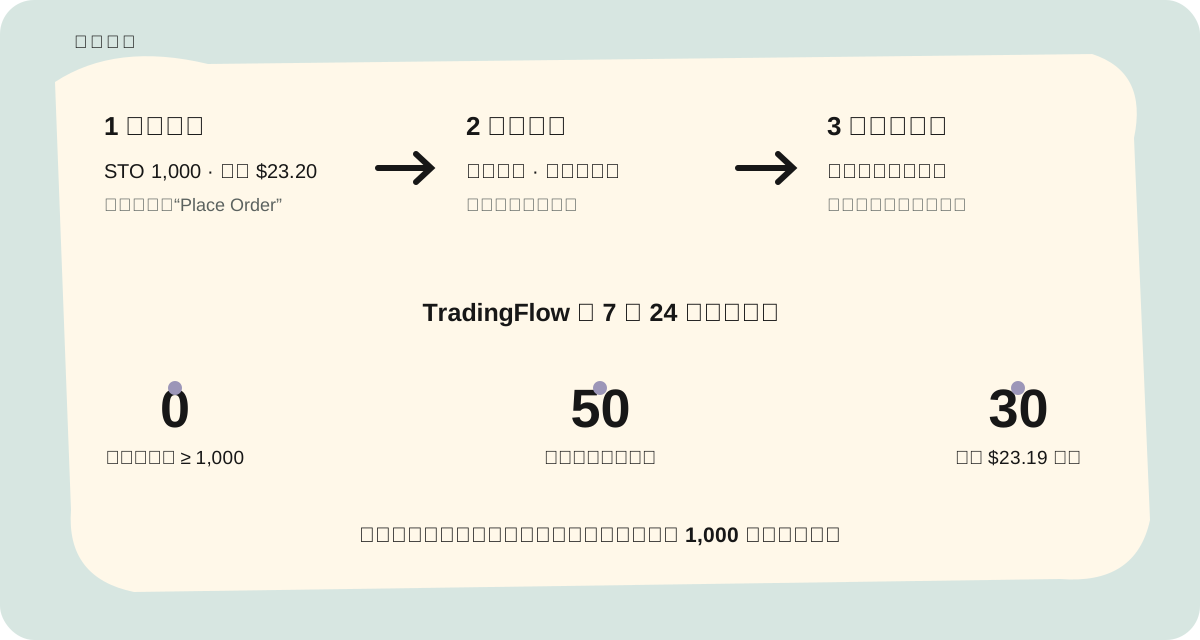
This distinction is the product value: TradingFlow can test whether the contract, price, timestamp, size, and positioning evidence support a media claim. It cannot turn anonymous exchange prints into proof of a named account.
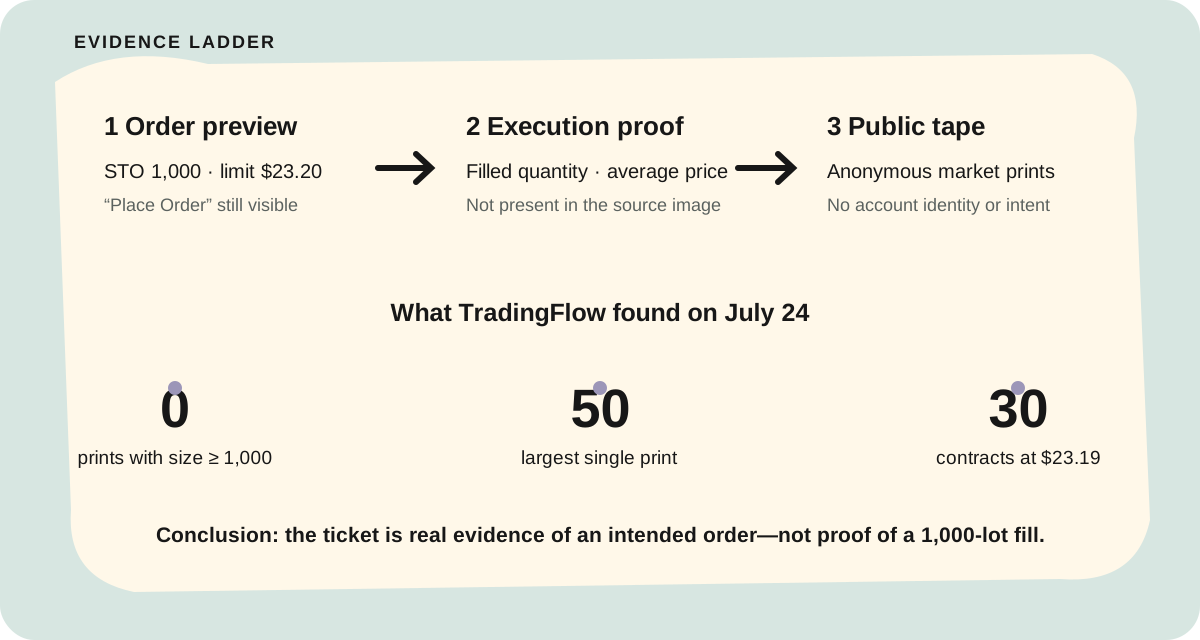
The evidence ladder matters: an order preview records an intention; a broker fill report records execution; public tape records anonymous market prints. Only the latter two can help verify a fill, and neither identifies the account from this post.
What the tape shows
The original post treats the screenshot as an executed $11.5 million bid. TradingFlow can test the contract, not the name on the caption.
Reproduce the exact contract in TradingFlow
We used authenticated Historical Option Trades in the TradingFlow test environment. Readers with the required access can open Historical Option Trades in the public app and reproduce the same workflow manually.
Start with:
- Mode: Historical
- Symbol: SPCX
- Date: July 24, 2026
- Type: PUT
- Days to Expiry: 147 to 147
- Strike Price: 115 to 115
- Time range: Full day
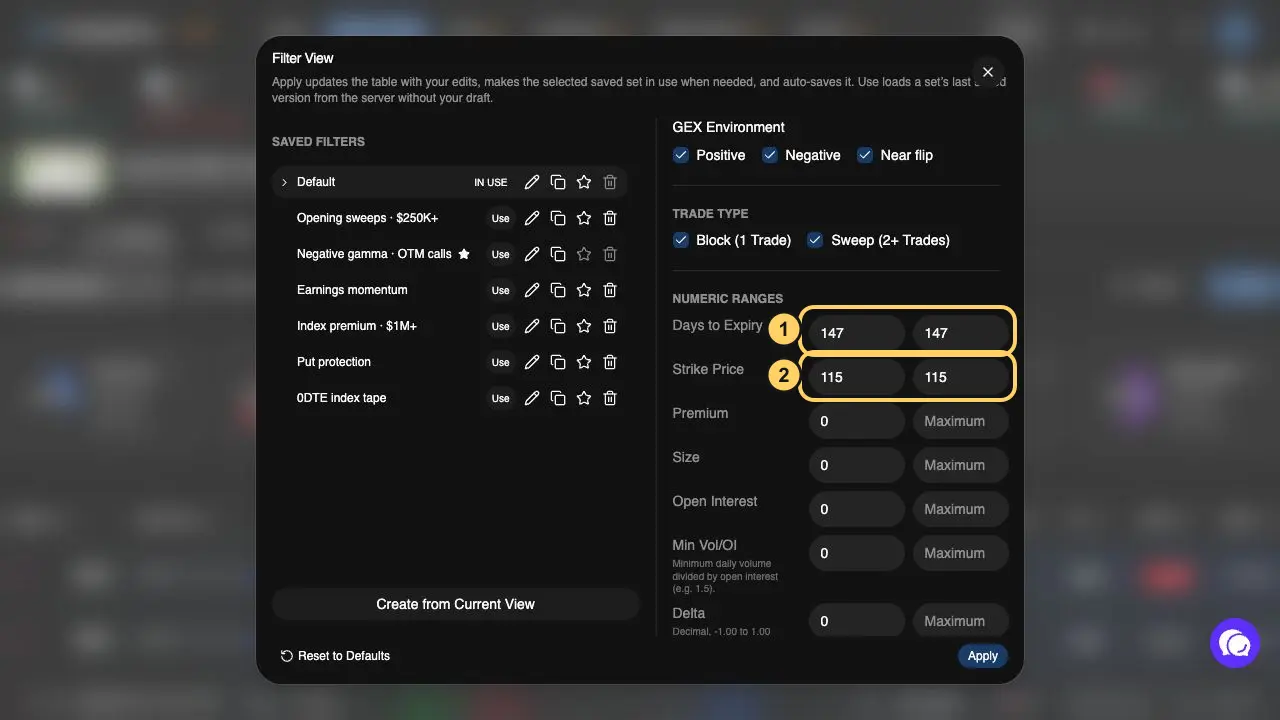
Annotated browser evidence from the authenticated test environment. Callout 1 fixes the Dec. 18 expiration through 147 DTE; callout 2 isolates the $115 strike. The public reproduction route is TradingFlow Historical Option Trades.
These filters returned actual prints for the contract. Sorting the tape by Size descending showed this largest-first sample:
| New York time | Tape side | Option price | Size | Gross premium | OI shown |
|---|---|---|---|---|---|
| 15:32:57 | Ask | $23.89 | 50 | $119.5K | 7,447 |
| 11:37:14 | Bid | $23.84 | 50 | $119.5K | 7,447 |
| 10:33:17 | Mid | $24.04 | 40 | $96.2K | 7,447 |
| 09:30:00 | Mid | $22.73 | 34 | $76.9K | 7,447 |
| 10:25:19 | Ask | $24.00 | 32 | $76.8K | 7,447 |
| 09:40:58 | Ask | $23.19 | 30 | $69.6K | 7,447 |
The table supports a narrower conclusion than the post: the contract traded around the cited price, but the largest displayed print was 50—not 1,000. A price match by itself cannot link an anonymous print to a named trader.
Step 3: test the reported 1,000-contract size
Next we added a minimum-size filter of 1,000 contracts while preserving the exact contract and date.
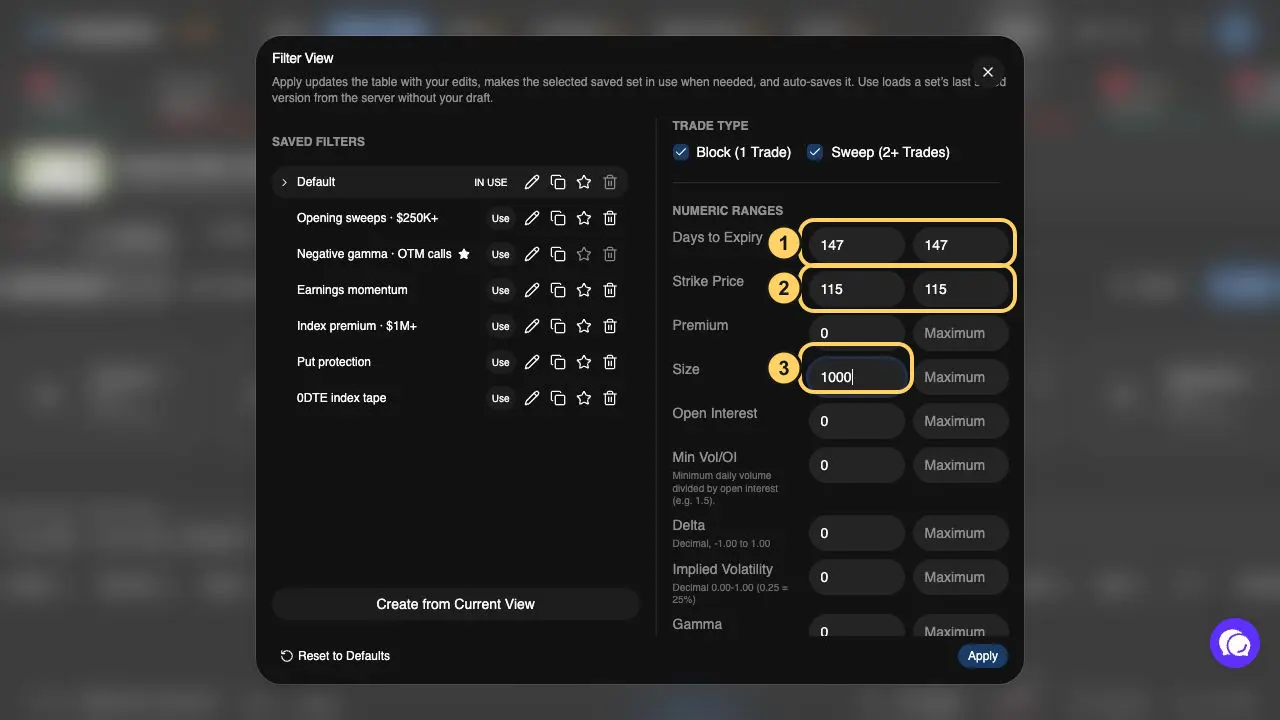
Callouts 1 and 2 retain the exact contract; callout 3 tests the viral claim directly. Apply the same settings from Historical Option Trades.
The committed filter set was:
SPCX · July 24, 2026 · PUT · DTE 147 · strike $115 · size ≥ 1,000
TradingFlow returned no matching rows.
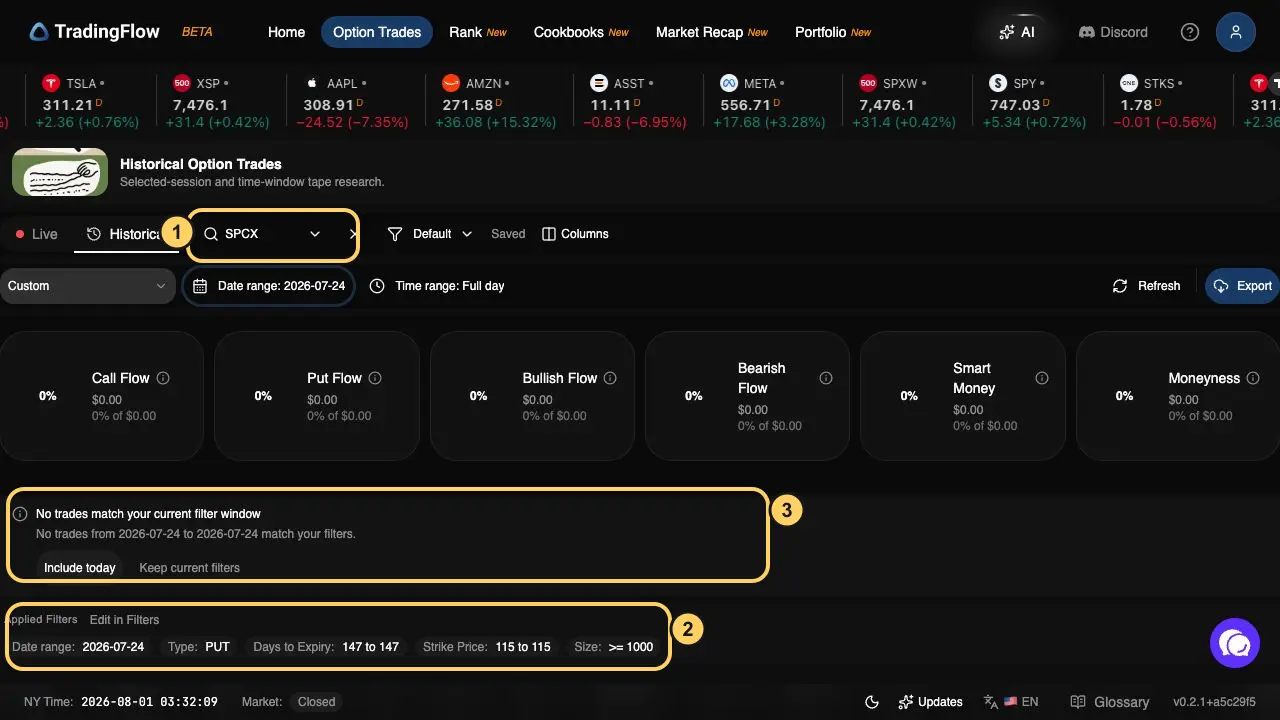
Callout 1 identifies SPCX and the July 24 session; callout 2 preserves the exact PUT, DTE, strike, and size criteria; callout 3 shows the zero-result state. This rules out a single 1,000-contract print in the captured tape view. It does not rule out a parent order divided into smaller executions.
This is why “we found no 1,000-lot print” is stronger and more honest than “the trade was fake.” A large limit order could be canceled, remain unfilled, receive a partial fill, or execute as multiple smaller prints. Public market data also cannot identify whose order participated in any particular print.
Step 4: ask whether OI proves sell-to-open
No. Open interest is useful, but it is not an account-level order flag.
The July 24 SPCX rows showed OI 7,447. The single-session view did not expose a broker-side open/close instruction or a point-in-time OI series we could use to attribute the order. OI is an aggregate count that normally updates after clearing. Even if a later snapshot rose, that would support net contract creation across the market; it would not tell us which account opened, which side that account took, or whether another participant closed an offsetting position.
TradingFlow also has an Opening Position filter. Its classification is a size/volume/OI screening heuristic, not broker-supplied “buy to open” or “sell to open” data. In this case, the tape’s largest visible size was 50 against OI of 7,447, so it does not produce anything resembling the claimed 1,000-lot opening confirmation.
There is another freshness boundary: in a wider Historical window, TradingFlow compares older flow rows with the latest known OI for the contract. That is useful current context, but it is not a point-in-time OI series for every trade date. Learn the clocks behind the columns in Option Chain & OI and the Option Trades tutorial.
The defensible conclusion is therefore:
The ticket shows an intended sell-to-open order. The captured tape does not verify a single 1,000-contract execution, and OI cannot connect anonymous contract-level changes to the claimed account.
Final finding: the idea is credible; the reported trade is unconfirmed
Supported by the source and TradingFlow evidence:
- The source prepared an order for 1,000 SPCX Dec. 18 $115 puts at a $23.20 limit.
- The contract traded on July 24 around that price.
- TradingFlow showed no single print of 1,000 contracts or more under the exact filters.
- The largest visible print in the size-sorted result was 50 contracts.
Not established:
- That the 1,000-contract order was submitted, filled, or filled completely.
- That any tape print belonged to the person named in the post.
- That the account sold to open rather than used another order instruction or multi-leg structure.
- That an OI change, by itself, identifies either side of this trade.
This is the practical value of an options flow scanner: not to turn every viral screenshot into certainty, but to separate contract facts, market prints, positioning context, and interpretation. Here, the alleged Duan Yongping buy-the-dip strategy is economically coherent, yet the available evidence does not verify the account attribution or the reported 1,000-contract execution.
To investigate the next market headline yourself, start at TradingFlow App Home, open Historical Option Trades, and convert the report into exact symbol, date, expiry, strike, price, and size filters. That is how a viral claim becomes a reproducible market-data check.
Educational market-data analysis only; not investment advice. Public option tape is anonymous and may not show every broker-side detail or parent-order relationship.
Related Articles
We Verified the Viral $7M Memory Put Trade. The Tape Needs Context.
TradingFlow’s historical option tape matches the six contracts and $422,135 gross premium in a viral memory-stock put post—but not its one-month, 40%-drop narrative.
Option Trades: Options Flow Scanner Tape, UOA & Block Trades
Live options flow tracker in TradingFlow: real-time tape, unusual options activity filters, sentiment, DEX, blocks, and premium flow after Rank shortlists.
A Five-Box Daily Vol Note, Written on SPY
张无忌wepoets publishes the same five boxes every day: gamma pin, skew, VRP, expiry OI, and a named print. This article follows that 冰火岛 note, then fills the boxes on SPY in Rank Symbols and on the tape.