Official template · basic · Option flow
Read the session’s put/call balance two ways.
Compare the session’s put/call print-count ratio with its premium ratio.
The report UI is recreated from the test app's Sep 25, 2026 session, not a live screen. A historical example with music; no narration.
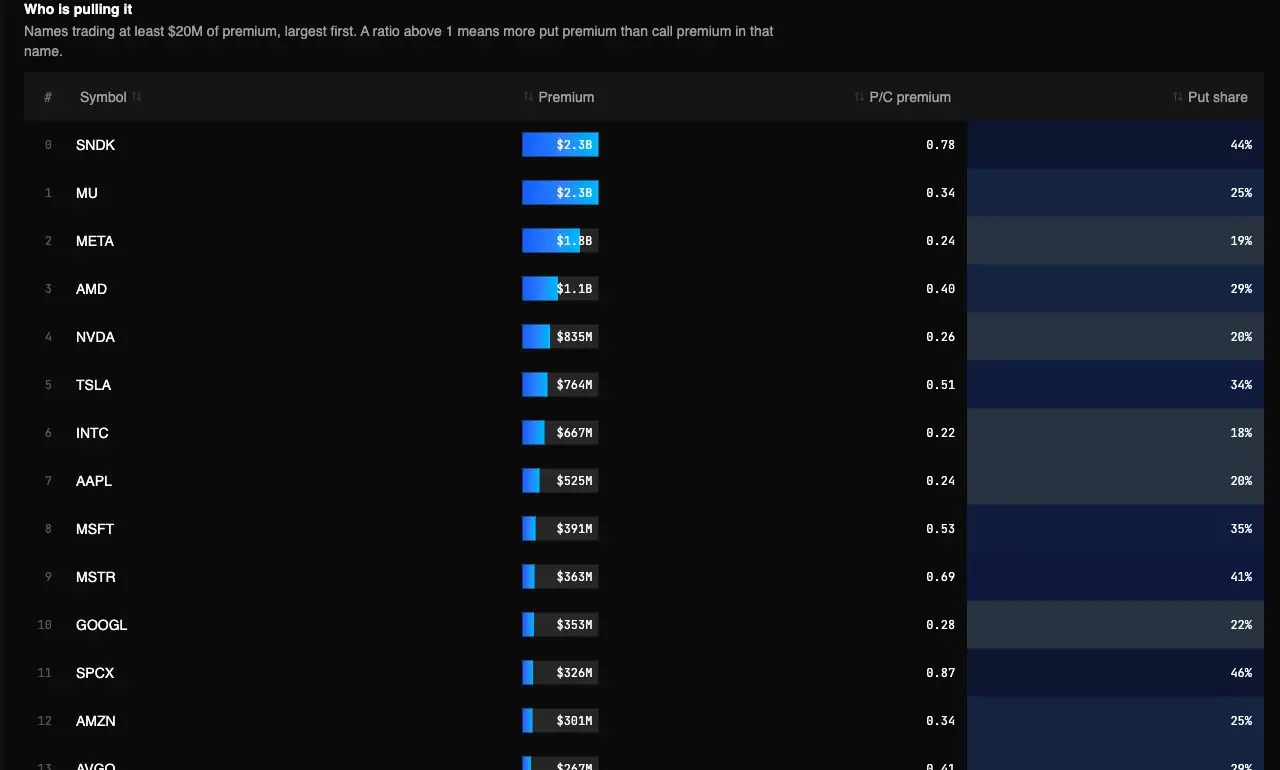
Captured Sep 23, 2026 on testapp.tradingflow.com. This is a historical example; results on this page do not refresh. Swipe across the image to inspect its columns.
- 01Single-name session
- 02Count + premium split
- 03Two P/C ratios
Check both measures and the names driving premium.
Read the output
- 01Put/call ratio by aggregated print count and by premium for single-name flow. The app labels the first measure “contracts”; its current calculation counts prints.
- 02Put share of total premium, and the call and put premium totals.
- 03Per-name ratios for the session’s heaviest names.
Keep in mind
A ratio above or below 1 is not a signal, and there is no universal threshold.
How to read it
From report to evidence01
Read both ratios
They can lean opposite ways when puts trade cheap and in size.
02
Check who is pulling it
One heavily hedged mega-cap can move a market-wide ratio on its own.
03
Compare against baseline
The Put/Call Ratio Deviation screener scores each name against its own trailing history.
Method and limitations
A one-screen Cookbook tool: the put/call split by aggregated print count and by premium, with the names driving it. Official app template: Put/Call Ratio Today.
What the report computes
- Put/call ratio by aggregated print count and by premium for single-name flow. The app labels the first measure “contracts”; its current calculation counts prints.
- Put share of total premium, and the call and put premium totals.
- Per-name ratios for the session’s heaviest names.
What it does not claim
- A ratio above or below 1 is not a signal, and there is no universal threshold.
- Neutral premium — spreads and hedges — is not directional and is excluded from the tilt.
- Index and ETF roots are excluded; this is single-name flow.
Reports the ratio by premium alongside the contract-count version, which is what stops a thousand cheap puts reading as a bearish session.
Frequently asked questions
- Which put/call ratio should I use?
- Read both. Print count gives each aggregated ticket equal weight; premium measures dollars traded. A tape can look put-heavy by one and balanced by the other.
- Is a high put/call ratio bearish?
- Not on its own. Puts are bought as hedges against long stock as often as they are bought as bets, and the tape cannot tell the two apart.
Related recipes
More learning resources
Related glossary
Related personas
The public page explains the report. Run the official template in TradingFlow for a selected completed market session.
Open Put/call snapshot