Option Chain & Open Interest
What the option chain is, how open interest updates overnight, and how to read ΔOI, Vol/OI, call/put walls, and max pain to tell fresh flow from old structure.
The option chain is the map of where the market is already positioned: every strike, how many contracts are open, and where the big clusters sit. The flow you watch in Option Trades tells you what traders are doing right now. The chain tells you what they have already built up. Reading them together is how you tell a fresh, meaningful trade from one that just churns existing positions.
This chapter is the reference for chain and open-interest terms. Other chapters link here instead of redefining them.
The Option Chain at a Glance
For any stock, every expiration has a grid of strikes. At each strike there is a call contract and a put contract, and for each you can see things like open interest, today's volume, and the live bid/ask. Calls are usually shown on one side, puts on the other, with the strikes running down the middle.
- Strike — the price the option can be exercised at.
- Call side — contracts that profit if the stock rises.
- Put side — contracts that profit if the stock falls.
- Strikes near the current stock price are at-the-money; far away ones are deep in- or out-of-the-money (see moneyness).
Open Interest (OI): Volume vs OI
Two numbers look similar but mean very different things:
- Volume = contracts traded today. It resets to zero every morning.
- Open Interest (OI) = total contracts still open and not yet closed or expired. It is cumulative across all days.
Think of it this way: volume is how much changed hands today; OI is how much is still on the books. A strike with huge OI is a strike where a lot of money is already parked.
How OI Updates: Overnight, Not Live
This is the single most important thing to remember about OI:
Open interest is not real-time. It is settled and published overnight by the clearinghouse, usually before the next morning's open. During the trading day, the OI you see is yesterday's closing number. Today's trades won't show up in OI until tomorrow morning.
So volume moves all day; OI only steps once per day. This is why TradingFlow always pairs recent flow with prior structure and labels them clearly — they are on different clocks. See the "recent flow + prior context" idea on Rank.
ΔOI: Did the Trade Open or Close?
ΔOI is the day-over-day change in open interest. It is how you confirm whether a big trade created a new position or unwound an old one.
| What you see | What it means |
|---|---|
| Volume ≈ +ΔOI | New contracts created → opening (new money taking a position) |
| Volume ≈ −ΔOI | Contracts closed → closing (positions being exited) |
| Volume >> ΔOI | Lots of trading, OI flat → churn (day trading, positions changing hands) |
Because OI only settles overnight, this is a T+1 confirmation: a large aggressive sweep is assumed to be opening during the day, and the next morning's ΔOI either confirms it (OI jumped by about the trade size) or reveals it was a close or just churn.
Vol/OI: The Freshness Ratio
Vol/OI is today's volume divided by existing open interest. It answers: how much did this contract trade today relative to what was already there?
- A high Vol/OI means today's activity is large compared to the standing position — unusually fresh, concentrated interest. This is "turnover shock."
- A low Vol/OI means the contract barely moved relative to a big standing position — old structure, quiet today.
Vol/OI is one of the headline signals on the Rank Contracts view precisely because it surfaces the freshest activity.
Call Walls, Put Walls, and Max Pain
Where OI piles up tells you which price levels matter:
- Call wall — the strike with the most call open interest above the current price. It often acts as resistance: as price climbs toward it, dealer hedging tends to slow the move.
- Put wall — the strike with the most put open interest below the current price. It often acts as support: dealer hedging tends to cushion the move down.
- Max pain — the strike where the most options (calls and puts combined) would expire worthless. Around expiration, price sometimes gravitates toward this level. Treat it as a rough magnet, not a guarantee.
These are probabilistic levels, not hard lines — news and fundamentals can blow right through them. The dealer-hedging mechanics behind walls are explained in Greeks & GEX.
Recent Flow vs Prior Structure (the freshness idea)
The core mental model for the whole product:
- Flow (what you see live) = traders acting right now. Moves every second.
- Structure (OI, walls, the chain) = positioning already built up. Updates once, overnight.
A signal is most meaningful when fresh flow lines up with structure — for example, heavy buying into a strike that then shows a real OI jump the next morning. Flow without an OI follow-through is often just noise.
Where to Find the Chain in TradingFlow
These structural views now live in the symbol drawer on Rank Symbols. Open any symbol's drawer and use its tabs:
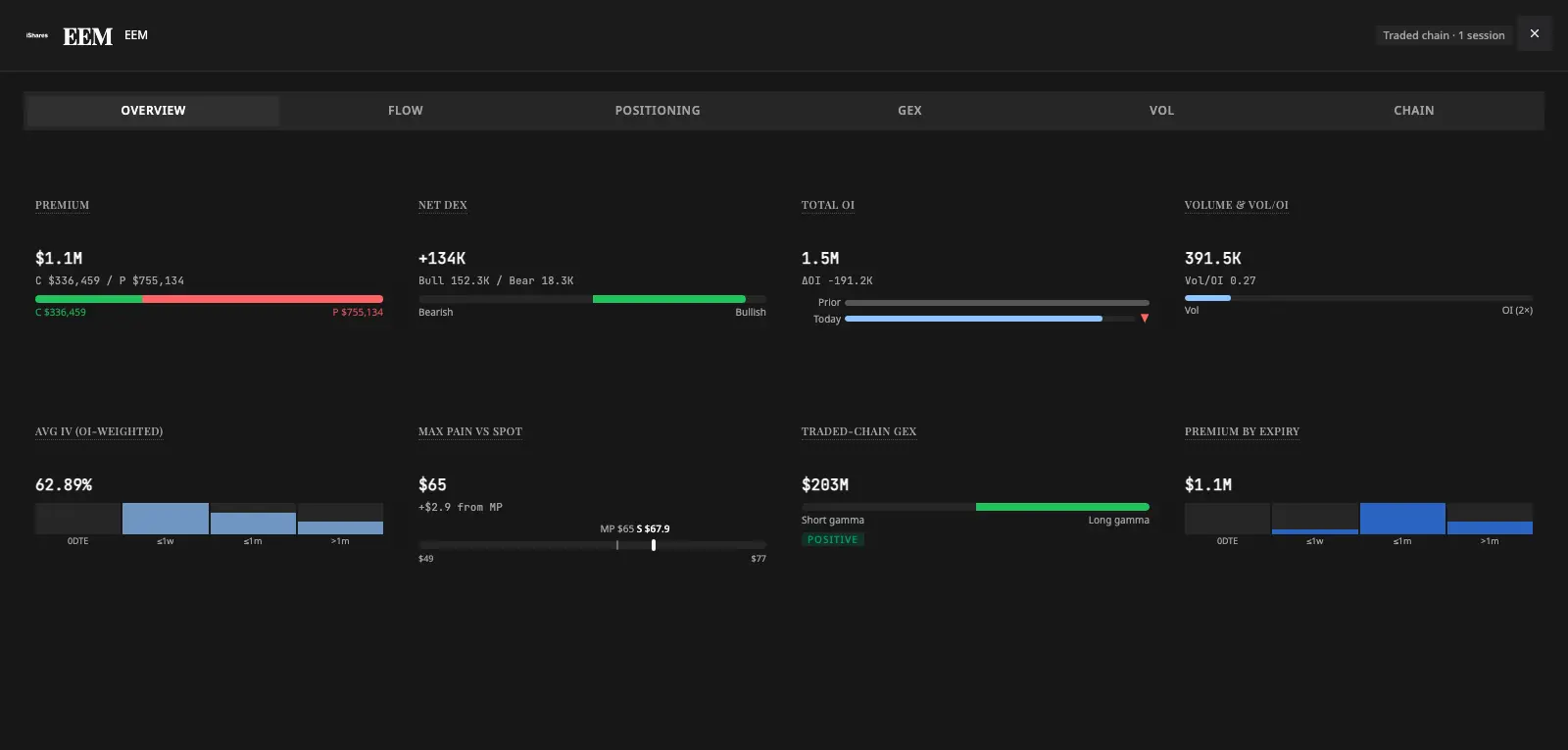 The symbol drawer surfaces structure tabs — including GEX and Chain — for the selected name.
- Chain tab — the traded-chain structure for the symbol, with live bid/ask quotes that load automatically. This tab is fully public: guests and unpaid users see the quotes too.
- GEX tab — the full-chain structural detail: net GEX, the zero-gamma flip level, the open-interest walls, the GEX ladder, and 0DTE structure (see Greeks & GEX).
A note on freshness inside the drawer: ΔOI shown there is a recent-snapshot comparison, not a tick-by-tick figure, and the structure snapshot is labeled for a specific date so its T+1 numbers are not mistaken for the intraday flow that drove the ranking.
What to Do Next
You now have the full vocabulary of the chain — strikes, OI, ΔOI, Vol/OI, walls, and max pain. Put it to work by scanning live activity: head to Option Trades to watch flow as it prints, or revisit Rank Symbols to open the Chain and GEX tabs on a name you're tracking.