Options & Flow Concepts
The plain-language glossary for reading TradingFlow: calls and puts, bid/ask side, sentiment, moneyness, DEX, DEI, Vol/OI, and what makes a trade unusual.
This is your plain-language reference for the words you'll see all over TradingFlow. Other chapters link back here instead of re-explaining the basics, so if a term ever looks unfamiliar, this is the page to come back to.
You don't need a finance background. Read it once to get the big ideas, then keep it open as a cheat sheet while you watch Option Trades or scan Rank Contracts.
Options in 60 seconds
An option is a contract that gives the buyer the right (not the obligation) to buy or sell a stock at a set price before a set date. Every option trade you see in TradingFlow is described by a handful of fields:
- Call — the right to buy the stock at the strike price. People buy calls when they expect the price to go up.
- Put — the right to sell the stock at the strike price. People buy puts when they expect the price to go down (or want protection).
- Strike — the agreed price at which the option can be exercised.
- Expiration (expiry) — the date the contract expires. Closer expiries are more of a short-term bet; further-out expiries are longer-term.
- Size — how many contracts changed hands in the trade. One contract usually represents 100 shares.
- Premium — the total dollars that moved in the trade. Roughly: price per contract x size x 100. Big premium = big money on the table, which is what most traders watch for.
That's enough to read a single row. The rest of this page is about reading intent — who was the aggressor, and what they were betting on.
Bid / Ask and what "aggressive" means
Every option has two live prices at any moment:
- Bid — the highest price buyers are currently willing to pay.
- Ask — the lowest price sellers are currently willing to accept.
The gap between them is the spread. Where a trade actually prints inside (or outside) that spread tells you who was in a hurry — and that's the single most important clue in flow reading.
- A buyer who pays at the ask is "crossing the spread" to get filled right now. That's an aggressive buyer — they wanted in badly enough to pay up.
- A seller who accepts the bid is "hitting the bid" to get out right now. That's an aggressive seller.
- A trade in the middle could be either side, so we treat it as neutral.
TradingFlow labels this as the trade's side:
| Side | Where it printed | What it suggests |
|---|---|---|
| Above Ask | Above the ask | Very aggressive buyer — strong conviction |
| At Ask | At the ask | Aggressive buyer — willing to pay up |
| Mid | Between bid and ask | Neutral — could be either party |
| At Bid | At the bid | Aggressive seller |
| Below Bid | Below the bid | Very aggressive seller — eager to exit |
The key idea: at-ask-or-above = the buyer was the aggressor; at-bid-or-below = the seller was the aggressor. There's no literal "buy" or "sell" flag in the market data, so TradingFlow infers the aggressor from where the trade printed.
Sentiment: bullish, bearish, or neutral
Now combine two things you already know — whether it's a call or put, and who was the aggressor (side) — and you get sentiment: a quick read on whether the trade leans bullish (betting up), bearish (betting down), or neutral.
The logic is simple once you see it laid out:
In words:
- Buying calls aggressively = betting the stock goes up = bullish.
- Buying puts aggressively = betting the stock goes down = bearish.
- Selling calls leans bearish; selling puts leans bullish (the seller is comfortable with the opposite outcome).
- Mid-market trades are neutral.
Sentiment is a helpful shorthand, not gospel — a single trade can be a hedge, a spread leg, or a roll. It's most useful in aggregate: lots of bullish premium piling into the same name is a louder signal than any one print.
Moneyness: ITM, ATM, OTM
Moneyness describes where the strike sits relative to the current stock price. It tells you how aggressive or speculative a bet is.
- In the Money (ITM) — the option already has real exercise value. For a call, the strike is below the stock price; for a put, above. More expensive, more like owning the stock.
- At the Money (ATM) — the strike is right around the current price. Most sensitive to near-term moves.
- Out of the Money (OTM) — the strike is beyond the current price (call strike above price, put strike below). Cheaper, more speculative, bigger payoff if it works. Heavy OTM buying often signals a strong directional bet on a move.
Seeing it in the table
All of these fields live side by side in the Option Trades table:
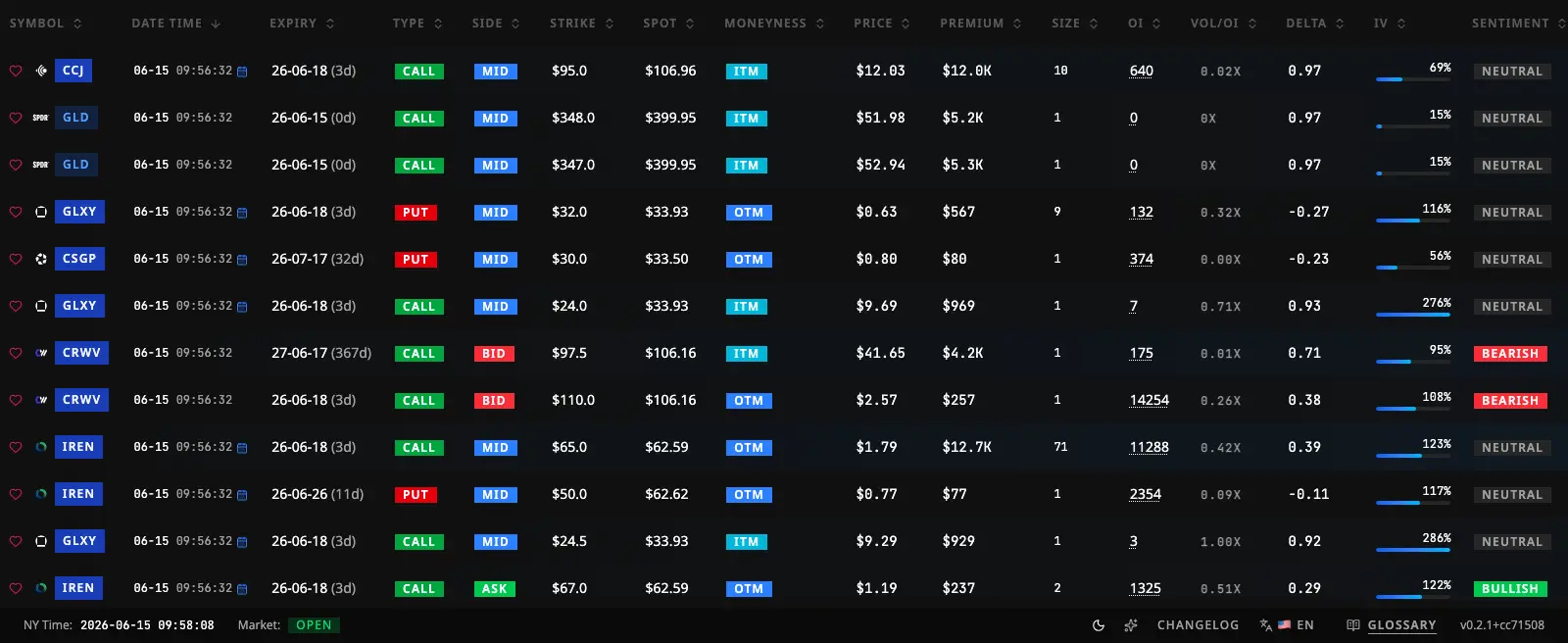
Each row is one trade: read Type (call/put) + Side together to understand the Sentiment shown on the right.
DEX and DEI: directional money, at a glance
Two metrics summarize how much directional conviction is behind the flow. You don't need the math — just the intuition.
- DEX (Delta Exposure) — a dollar-weighted measure of how directional a trade or a group of trades is. Big positive DEX means a lot of money is positioned for the stock to rise; big negative means positioned for a fall. Think of it as "net directional dollars."
- DEI (Delta Impact) — a measure of how much a trade adds to or removes from the existing directional pressure. It helps separate fresh, market-moving bets from routine activity.
Both build on delta, one of the option Greeks. For the full picture of delta, gamma, and how dealer positioning can pin or accelerate a stock, see Greeks & GEX.
Vol/OI: the unusualness signal
Two numbers tell you whether a contract is seeing real, fresh interest:
- Volume (Vol) — how many contracts traded today.
- Open Interest (OI) — how many contracts are already open (held overnight from prior days).
The ratio Vol / OI is one of the fastest ways to spot something new happening:
- Vol/OI around or below 1 — today's activity fits within positions that already existed. Routine.
- Vol/OI well above 1 — today's volume dwarfs what was open before, meaning new positions are being opened. That's a flag worth a closer look.
A deeper look at OI, how it builds over days, and what rising-OI-plus-rising-volume means lives in Option Chain & OI.
What makes a trade "unusual" — and "smart money"
Unusual options activity (UOA) simply means an option (or a whole stock's options) is trading far more than normal. "Smart money" is the informal label for large, conviction-sized flow that often comes from institutions. None of it is a guarantee — it's a way to focus your attention on where real money is moving.
A trade tends to stand out when several of these line up:
A practical rule of thumb:
- A few very large trades (block trades) often point to institutional conviction — that's the flow most traders care about.
- Many tiny trades are more often retail or market-maker activity and carry less directional signal.
- The strongest setups stack signals: big premium + high Vol/OI + aggressive side + one-directional sentiment.
You don't have to weigh these by hand. TradingFlow surfaces the standouts for you in Rank Contracts (the loudest individual contracts) and on the live Option Trades feed.
What to do next
Now that the vocabulary makes sense, go watch it live. Open Option Trades to see side, moneyness, and sentiment update in real time, then jump to the ranked standouts in Rank Contracts.
To go deeper on the metrics, continue to Greeks & GEX, and to understand open interest in depth, read Option Chain & OI.