Official template · basic · Key levels
Find the modeled max-pain strike for a symbol.
Answer "where is max pain for this ticker" in one look, without reading a full structure report.
The report UI is recreated from the test app's Sep 25, 2026 session, not a live screen. A historical example with music; no narration.
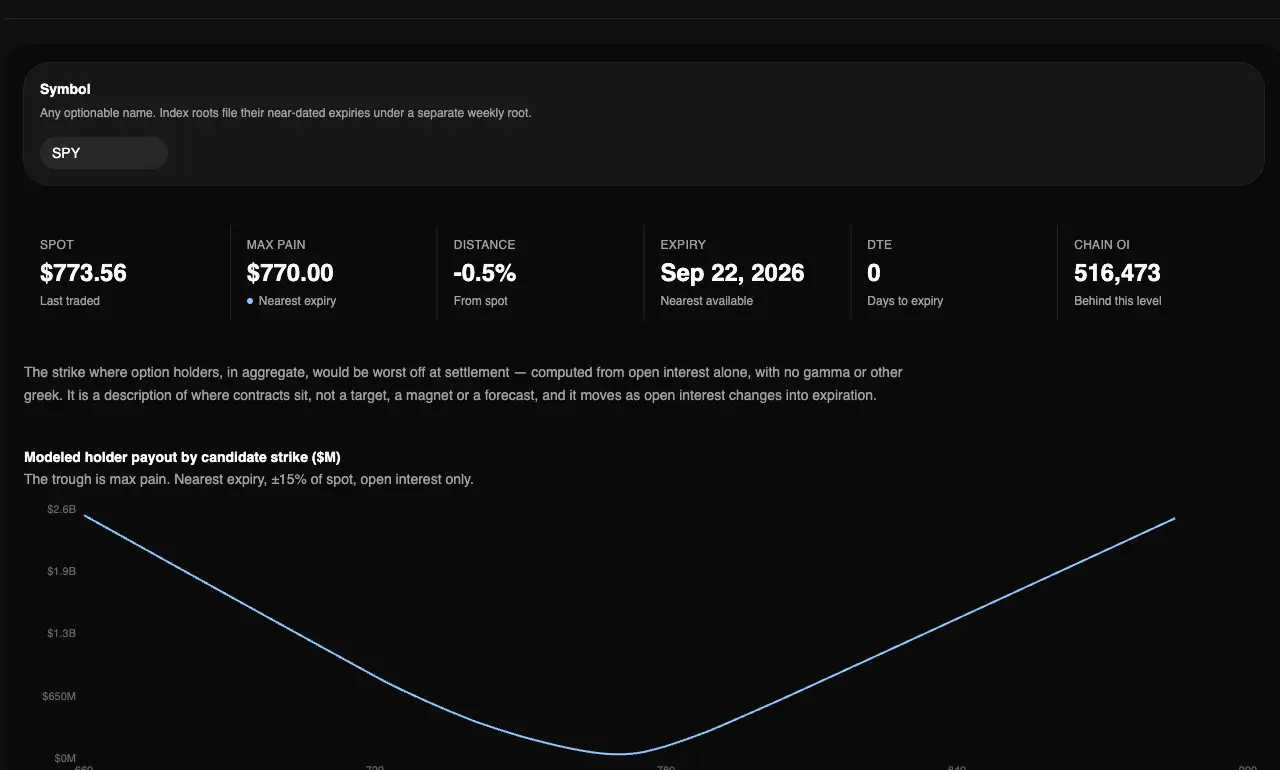
Captured Sep 23, 2026 on testapp.tradingflow.com. This is a historical example; results on this page do not refresh. Swipe across the image to inspect its columns.
- 01Symbol + nearest expiry
- 02OI payout curve
- 03Minimum payout strike
An OI-only model, not a settlement forecast.
Read the output
- 01The strike minimising aggregate holder payout at settlement, from open interest only.
- 02Distance from spot, the nearest available expiry, and its days to expiry.
- 03Chain open interest behind the level, so a thin expiry is visible as thin.
Keep in mind
Price is not required to settle at max pain, and the level moves as open interest changes.
Explore the concept behind this report
Max pain is the underlying price that theoretically minimizes total option-holder payoff at expiration, context, not destiny.
How to read it
From report to evidence01
Type a symbol
The tool resolves that name’s own nearest expiry, including 0DTE when one exists.
02
Read the distance
How far the level sits from spot matters more than the strike on its own.
03
Check the payout curve
The trough is the level. A shallow trough means the strike is barely preferred over its neighbours.
Method and limitations
A one-screen Cookbook tool: type a symbol, get its max pain strike at the nearest expiry, the distance from spot, and the open interest standing behind the level. Official app template: Max Pain Lookup.
What the report computes
- The strike minimising aggregate holder payout at settlement, from open interest only.
- Distance from spot, the nearest available expiry, and its days to expiry.
- Chain open interest behind the level, so a thin expiry is visible as thin.
What it does not claim
- Price is not required to settle at max pain, and the level moves as open interest changes.
- No gamma weighting — this is not a GEX wall and can disagree with one.
- A max pain drawn from a thin chain is arithmetic, not evidence. Read the open interest beside it.
Reports the chain open interest standing behind the level, so a max pain drawn from a thin expiry is visibly thin rather than quoted with false confidence.
Frequently asked questions
- Does price have to close at max pain?
- No. Max pain describes where contracts currently sit, not where price must go. It is recomputed from open interest every session and moves as positions change.
- How is this different from a call or put wall?
- Walls weight open interest by gamma; max pain does not weight at all. They answer different questions and routinely point at different strikes.
Related recipes
- Max painCompare max pain to walls and GEX instead of treating one pin number as destiny.
- Gamma structureLocate modeled concentration strikes and the highest net-GEX strike, then compare them with session flow.
- OI ladder · AdvancedSee where open interest actually sits by strike before you treat a GEX wall as the book.
More learning resources
Related glossary
Related personas
The public page explains the report. Run the official template in TradingFlow for a selected completed market session.
Open Max pain lookup